Small World Discoveries
by Tony Enticknap - tickspics
Focusing on insects, arachnids, fungus and other small nature subjects from East Dorset and the New Forest ...
Welcome to the macro photography offshoot of tickspics.com, which focuses on 'small world' nature subjects from around my local area of East Dorset and the New Forest and, occasionally, from a little further afield. The 'about' page provides a bit of background information and further details regarding the concept, but in essence the site is as much about discovery and learning as taking photos.
Although it acts as a personal record of my findings, I hope that if you share similar interests you will enjoy browsing through the various collections and articles and, if you like what you see, that you'll periodically come back to check out the latest 'updates' as there will always be something new to discover as the site evolves.
Whilst the more familiar insect orders are well represented, my primary interest is with the smaller inconspicuous species that are often ignored. And that doesn't just mean invertebrates as there are other fascinating subjects to photograph, such as lichens and slime mould for example that I knew relatively little about until I started this project.
Navigation is straightforward with most sections accessible directly from this 'home' page, which takes less clicks to return and take another path than negotiating an extended drop-down menu. The thumbnail images will invariably take you to a list of the species, and then to separate family or species accounts with additional photos and varying amounts of information regarding classification, identification, biology and distribution. And, new for 2026, I've started a separate article-based section regarding woodland habitats and ecology to accompany the soil and leaf-litter invertebrates where I aim to take a deeper look at a whole range of associated subjects as confirmed below.
HYMENOPTERA
Bees, Wasps, Ants and Sawflies
Hymenoptera is our largest insect order with around 7,800 species, of which nearly 90% are wasps. It is a very diverse group with a rather complex taxonomic structure that can be a bit tricky to understand and, although it’s important to relate to the formal classification system when listing individual species and their associated families, I've adopted the simple approach here to enable quick access to the appropriate section.
APOCRITA | Aculeata
Bees

APOCRITA | Aculeata
Stinging Wasps

APOCRITA | Parasitica
Parasitic Wasps

APOCRITA | Aculeata
Ants

SYMPHYTA
Sawflies

DIPTERA
True Flies
The latest update of the ‘Checklist of the Diptera of the British Isles’ now recognises close on 7,300 types of flies, which is not that far behind Hymenoptera in terms of the total number of species. In fact, the two orders together account for around 60% of all British insects. There are 109 Diptera families, of which 84 are placed within the more advanced Brachycera suborder, and the remaining 25 classified under the Lower Diptera suborder Nematocera. Although gnats and midges win the contest for the sheer number of species, it’s some of the larger Brachycera fly families that attract more general interest with the most photographed being hoverflies, which is why I’ve now included a separate direct link.
NEMATOCERA
Craneflies, Gnats, Midges

BRACHYCERA
Flies

Syrphidae - Hoverflies

COLEOPTERA
Beetles
With well over 4,000 recognised species, Coleoptera is the third largest group of British Insects although, when you look at the incredible number and variety of beetles worldwide, they totally eclipse all other insect orders by a ratio of just over 2:1.

HEMIPTERA
True Bugs and Hoppers
Closely associated with beetles, but with their own distinct characteristics, true bugs are in the order Hemiptera together with various hoppers and numerous plant-parasitic species. My primary interest is with the bugs and hoppers, which are separated into their own suborders.

LEPIDOPTERA
Butterflies and Moths
I suspect that butterflies are our most photographed insects even though there are only 57 resident British species. They are in the same taxonomic order as moths, but separated into their own superfamily Papilionoidea. Butterflies are obviously popular because of their bright colours and the fact that they're daytime flying species, whereas most moths are nocturnal. There are around 2,500 species of moth on the British list in 65 families, which are divided into macro and micro moths.
Butterflies

European Butterflies

Pending
Moths

The remaining insect orders are often placed within convenient groups of similar and/or related species:
NEUROPTERIDA - Lacewings and Allies
NEUROPTERA
Lacewings

MEGALOPTERA
Alderflies

MECOPTERA
Scorpionflies

RAPHIDIOPTERA
Snakeflies

PALEOPTERA and Riverflies
ODONATA
Dragonflies & Damselflies

Ongoing
EPHEMEROPTERA
Mayflies

TRICHOPTERA
Caddisflies

PLECOPTERA
Stoneflies

Grasshoppers and related insects
ORTHOPTERA
Grasshoppers & Crickets

DERMAPTERA
Earwigs

BLATTODEA
Cockroaches

PSOCODEA
Barkflies

Plant parasites
HEMIPTERA > STERNORRHYNCHA
Aphids & Psyllids

Pending
Scale Insects

Pending
APTERYGOTA (wingless insects)
ARCHAEOGNATHA
Bristletails

New Section
ZYGENTOMA
Silverfish

New Section
ARACHNIDA
ARACHNIDA encompasses the second largest group of terrestrial arthropods after INSECTA and, although the variety of species that occur in the UK is far less than can be found in many areas of the world, it's still a very interesting and diverse group.
The phylogenetic relationship and higher-level taxonomic classification are still unresolved, but basically there are four 'divisions' which are ARANEAE (spiders) and the much smaller OPILIONES (harvestmen) order as featured here, and ACARI (mites) and PSEUDOSCORPIONES that are covered in the following section.
I've also included a separate album showing a small selection of some of the exotic tropical spiders or more unusual arachnid species that I've photographed overseas.
ARANEAE
Spiders

OPILIONES
Harvestmen

ARACHNIDA
Overseas Collection

New Section
I'm still pondering over the best way to lay out this section, but at present the following arrangement seems like a reasonable way of grouping and representing the species I want to feature even if the inclusion of slugs and snails is a bit borderline. The other groups definitely fit the criteria as they represent the primary non-insect species you'd expect to find in this type of habitat, but there are still a few more woodland creatures that need to be covered and there's a lot more to learn so please read on .....
MYRIAPODA
Centipedes & Millipedes

ISOPODA
Woodlice

GASTROPODA
Slugs & Snails

Pending
COLLEMBOLA
Springtails

ACARI
Mites & Ticks

New Section
PSEUDOSCORPIONES
False Scorpions

New Section
Soil and Leaf-litter Invertebrates
Woodland ecology and the cryptozoa
Whilst the above reference to 'soil and leaf-litter invertebrates' provides a suitable and convenient header for this final group of species, down on the forest floor they're part of a wider community of creatures that not only live in the soil and humus, but also on or around deadwood.
These woodland microhabitats are as varied as the species that live there, which makes them great places to explore as you never know what you're going to see. Apart from the various centipedes, millipedes, woodlice, springtails and mites you’d expect to find hidden away in these dark and invariably damp places, there are bound to be other species such as the odd spider or beetle, as well as some of the soil organisms I haven’t yet mentioned like diplurans or symphylans, enchytraeids and earthworms for example, or various types of insect larvae.
They can be broadly separated into three ecological groups; the xylophagous or saproxylic species that depend on dead or decaying wood for at least part of their life cycle; other cryptozoic species that co-exist in the same microhabitats either as residents or opportunists seeking food; and the soil organisms that can often be found on the ground under deadwood and litter.
Although many of these species have already been individually covered within their respective albums, this final section brings them together in a series of 'blog-like' articles centred around habitat and lifestyle. The concept and format, which is explained in greater detail on the following page, also encompasses the associated subject matter
of woodland ecology and the role of fungi as noted below.
The articles are all about learning and gaining knowledge, and being able to share what I've managed to find, which for me is what Small World Discoveries is all about.
Cryptozoa

Recently published
Soil organisms

Pending
Life on the forest floor

Pending
Saproxylic invertebrates
Woodland ecology
As my general interest in invertebrates has widened to include species that were previously ignored, such as earthworms, I've had to take a closer look at my local woodlands in order to gain a better understanding of the habitat and vegetation, as well as the geology of the area and how it impacts the soil. It proved to be an informative and useful exercise that ended up covering a much broader range of subjects than I originally envisaged such that I'm now starting to see woodlands in a completely different way. It also provided the impetus to take more notice of the role of mycorrhizal and saprotrophic fungi.

Habitat classification
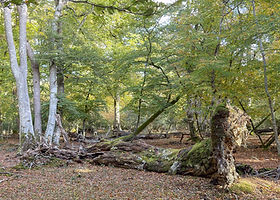
Soil and deadwood
Fungal connections
Exploring the closely allied worlds of fungi, lichens and slime moulds has been a natural progression of discovery where I've become particularly fascinated with the smaller subjects - initially lichens that I spent a few months studying that have their own section featuring well in excess of a hundred species and then, more recently, some of the wood-rotting jelly, cup and flask fungi, plus various other unusual forms such as pin moulds. And finally, the intricate and often incredibly tiny shape-shifting slime moulds that are proving to be the most challenging group of species that I've tried to photograph.

Mycelium and mycorrhizal fungi

Saprotrophic fungi

Asexual fungi, pin moulds .....

Lichens

Slime Mould
- IMPORTANT -
Please note that this website has been specifically designed for larger screens, not for a smartphone where the layout and much of the functionality are lost. If it has to be viewed on a mobile, please try using the browser 'desktop mode' if supported on your device and view horizontally. It's not ideal, but it should work.
Another unfortunate consequence of not being 'mobile friendly' is that it affects the SEO ranking, such that the site often fails to appear in search results. Obviously, that's a bone of contention I have to accept, but if you get value from the site then please share the address with anyone that has similar interests.