Small World Discoveries
by Tony Enticknap - tickspics
Focusing on insects, arachnids, fungus and other small nature subjects from East Dorset and the New Forest ...
Woodland ecology and the cryptozoa
INTRODUCTION
Up to this point, the website has purposely grouped associated species together in their respective taxonomic orders,
duly separated into three clearly defined sections; insects, arachnids and soil and leaf-litter invertebrates.
Insects naturally take centre stage and, apart from a couple of minor groups such as Thysanoptera (thrips), all of the orders are represented to some degree. Similarly with the arachnids, although the smaller species, Acari (mites and ticks) and the pseudoscorpions are separated as they're better placed with the Myriapods (centipedes and millipedes), Isopods (woodlice) and Collembola (springtails).
However, as previously noted, there are a few organisms such as diplurans, symphylans, enchytraeids (pot worms) and earthworms that have not been individually featured, but will now be covered in this collective ‘article-based’ section.
Wildlife photography naturally makes you take notice of the habits, general behaviour and interactions of the creatures you're watching. The situation with insects is no different to life on the African plains, but just on a smaller scale. If you put your camera down and take time to look at the bigger scene, you'll find that there's probably a lot more going on than you realised. This certainly applies to invertebrate communities particularly as there are various habitats that could provide opportunities for observation and study, but probably the most diverse group are the cryptozoic species that live within
the top layer of soil or on the ground in leaf-litter, under logs and stones or on decaying deadwood. It's an unfamiliar term,
but the cryptozoa - derived from the Greek kruptos and zōē, meaning ‘hidden life’ - is used in ecology when referring to the creatures that live in these places or any similar dark microhabitat, such as beneath the bark of both fallen and mature standing trees, within knot holes and hollows, that could be considered a safe haven where invertebrates can live in a relatively cool, stable environment that is shaded from direct sunlight.
These microhabitats can be found almost anywhere where there are trees, including grassland, heathland, parks and gardens, but obviously the biggest concentration occurs in woodland and forests which is my main focus here.
Deadwood is a key component of forest ecosystems as it provides a home or nutrient resource for many species, but it's a bit of a wide-ranging term that could be used to describe anything from a fallen branch to cut timber or decomposed wood to dead sections of a standing tree, so it needs to be broken down - literally in the case of certain saproxylic species - and understood. Similarly with the soil and the trees themselves, which is why the following series of articles are separated into two distinct sections starting with woodland ecology. This section takes a broad look at the structure of the woodland habitats in my area and their associated vegetation communities, before moving on to the geology, organic make-up of the underlying soil and humus, and the different forms of deadwood and wood decay in part 2. The final subject links nicely with part 3 entitled fungal connections, which has become far more detailed than I originally anticipated and, as such, now extends to three pages - 3.1: mycelium and mycorrhizal associations, 3.2: saprotrophic decomposers and wood rotting fungi, and 3.3: other fungal species such as pin moulds, lichenised fungi and various related topics. And last, but certainly not least, slime mould.
The cryptozoa section is also broken down, again split into three parts - soil organisms and the mesofauna that are more typically associated with the soil rather than deadwood, then life on the forest floor for the typical species you'd expect to find in the leaf-litter and hidden away under deadwood or in cryptozoic niches, and lastly the saproxylic invertebrates that depend on dead or decaying wood for at least part of their life cycle.
FORMAT
Bearing in mind that this is an ongoing project that I'm starting from scratch, it's obviously going to take a fair while to develop. Content will be added on a piece-by-piece basis in no set order, so please revisit from time to time as I hope that these seemingly random articles will eventually take shape.
The layout and format of having six separate parts should allow for fresh content to be added either as a new article or additional information or photos regarding an existing species or topic. Although I want to maintain some degree of continuity, I will be mixing the content up a bit as I think it will make for a more interesting read. However, at the same, I need to have a convenient way of jumping to a particular topic, so I shall add an appropriate link to the following 'quick access index' for each new entry. as well as having a separate index for each part.
NB. Woodland ecology still 'work in progress', but now live. Cryptozoa coming soon!
Woodland ecology

Habitat classification
(part 1)
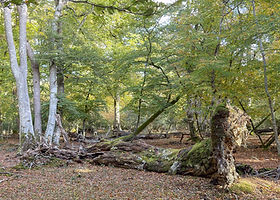
Soil and deadwood
(part 2)
CONTENTS:
1.1: Local woodlands > East Dorset > Cranborne Chase > The New Forest
1.2: Classifying woodland > New Forest vegetation communities > NEC - National Vegetation Classification
1.3: Ancient woodland > Ancient and veteran trees
2.1: Geology and soil groups > Soil attributes - structure and water retention, soil pH, horizons and soil profiles.
Woodland soils > Humus and the importance of leaf-litter
2.2 Deadwood > Fugal wood-decay - examples of white-rot and brown-rot
Associated information:
Appendix 1A: A-Z list of tree and shrub species
Appendix 1B: A-Z list of ground-covering and field layer species
Appendix 2A: Soil classification - additional information
Fungal connections

Mycelium and mycorrhizal fungi
(part 3.1)

Saprotrophic fungi
(part 3.2)

Asexual fungi, pin moulds ....
(part 3.3)

Lichens
(links to a separate section)

Slime Mould
(part 4)
CONTENTS:
3.1: Fungal mycelium
3.1a: Mycorrhizal fungi - specifically the ectomycorrhizal 'mushrooms' and their symbiotic relationship with trees
> Mycorrhizal fungi - diversity in a genus (Amanita)
3.2: Saprotrophic fungi
> Brackets and Polypores > Cauliflower fungus > Corticoid (crust) fungi > Pleurotoid agarics
> Saprotrophic agarics > Bonnets > Clavaroid (coral) fungi > Jelly fungi > Cup fungi > Flask fungi
3.3: The confusing world of asexual fungi
3.3a: Mucorales - pin mould
3.3b: Myxomyceticolous fungi
3.3c: Dendrostibella smaragdina
3.3d: Cystofilobasidium macerans - Sap Yeast
3.3e: Fungal guttation
3.3f: Lichenised fungi
3.3g: Pucciniomycetes - rust fungi
Associated information:
Appendix 3A: Ectomycorrhizal fungi partnerships (pending)
CONTENTS - Slime Mould:
4.1: Classification
4.2: Plasmodium
4.3: Fruiting bodies and terminology
4.4: Ceratiomyxales > Ceratiomyxaceae
4.5: Cribrariales > Cribrariaceae
4.6: Reticulariales > Reticulariaceae
4.7: Trichiales > Arcyriaceae, and Hemitrichiaceae / Trichiaceae
4.8: Stemonitidales > Amaurochaetaceae and Stemonitidaceae
4.9: Physarales > Didymiaceae, Lamprodermataceae and Physaraceae
Cryptozoa

Recently published
Soil organisms
(part 5)

Pending
Life on the forest floor
(part 6)

Pending
Saproxylic invertebrates
(part 7)
CONTENTS:
5.1: Categorisation of organisms
5.3: Mermithid Nematodes
5.4: Symphylans
5.5: Diplurans
5.6: Other soil mesofauna
5.7: Nymphs, juveniles and 'pygmy' forms