Small World Discoveries
by Tony Enticknap - tickspics
Focusing on insects, arachnids, fungus and other small nature subjects from East Dorset and the New Forest ...
Habitat classification
Before looking at the species that can be encountered on the forest floor, it's a good idea to have some basic knowledge about woodland habitats and their associated vegetation communities.
1.1: Local woodlands > East Dorset > Cranborne Chase > The New Forest
1.2: Classifying woodland > New Forest vegetation communities > NEC - National Vegetation Classification
1.3: Ancient woodland > Ancient and veteran trees
Associated information:
Appendix 1A: A-Z list of tree and shrub species
Appendix 1B: A-Z list of ground-covering and field layer species
Local woodlands
1.1 (v.1)
Seeing that all of the associated articles in the other parts of this series refer to personal experiences and discoveries, it makes sense to start with a bit of information regarding the woodland sites that I regularly visit as the structure and nature of these sites obviously has an important bearing on the species that I'm likely to encounter.
It's been an interesting exercise in itself as I thought I knew these woodlands pretty well, but in writing up these articles I realised that I've never paid that much attention to the shrubs and trees. I might know where to find certain trees, such as oaks for example as they're always good for insects like parasitic wasps, but I would have struggled in describing these sites in any more than general terms. In fact, it's only since I've come to understand the association between certain fungi and trees that I've realised that describing a particular woodland area as simply broadleaved or coniferous is only okay to a point.
So my aim here is to list the main woodland sites in my area, including any pertinent information regarding the terrain and general structure, especially regarding the tree species, that could prove useful in the future.
Although it becomes obvious when you start looking at these sites, it's worth noting that in the area of East Dorset where I live most of the local woodland is coniferous. There are a few places I can visit where there are coppices or small woods, but the closest broadleaved woodland is nearly half an hour away, which isn't far, but it's not within the 15-minute radius of home that I regard as local.
For convenience and geographical separation I've split these sites into three separate articles: East Dorset and Cranborne Chase,
and then a comprehensive look at The New Forest.
East Dorset
1.1a (v.1)
My nearest location to home is Horton Wood (Queen's Copse) which is situated to the north of Holt Heath on the edge of an extensive area of Dorset farmland that spreads across Cranborne Chase. It's a 77-hectare site managed by Forestry England that's split into two narrowly joined sectors with the main access route leading through to the main area known as Queen's Copse. It has a 4km long circular trail with only one or two transecting paths and, due to the nature of the site, it is quite limiting, but it is close to home and I have found a few interesting insects there over the years. However, it was subjected to heavy felling in 2024, which has greatly affected the whole look and feel of the place so, at the moment, I'm only visiting every few months. It's said to be ancient in origin, but as a planted site primarily comprising conifers that were first established 50-70 years ago. The main species are Douglas Fir [Pseudotsuga menziesii] and European Larch [Larix decidua], but there are a couple of areas of mixed woodland including an area of Small-leaved Lime [Tilia cordata].
A similar distance from home in the opposite direction is an extensive area of woodland that I simply refer to as Ringwood Forest, but then separate into three distinct locations for recording purposes:
The main area I visit is Ebblake North, which is just south of Verwood on the road out to Ringwood; then Ebblake Bog (SSSI) a smaller area of forest, which is on the other side of the road and best accessed from a cut-through to Moors Valley which is even closer to home; and finally a further separated area I occasionally visit at Ashley Heath.


Ringwood Forest - Ebblake North
Ebblake Bog Forest
The total area of Ringwood Forest extends to just over 900-hectares and is predominantly coniferous woodland mainly consisting of Corsican Pine [Pinus nigra] and Scots Pine [Pinus sylvestris], with some Western Hemlock [Tsuga heterophylla] according to the forestry plan. Felling takes place over three-year cycles and, as far as I'm aware, the areas I visit aren't due to be felled during the next few years.
White Sheet Plantation borders the southern side of Holt Heath. It's very similar to the other coniferous forests in the area
and doesn't have any specific appeal apart from its location, which means that you can explore woodland and heathland during the same visit.
Although situated a short distance away, the local forestry plan links White Sheet with Cannon Hill and Uddens Plantations, the latter bisected by the A31. Cannon Hill holds more interest and is more varied as it has some mixed woodland including Beech [Fagus sylvatica] and Sweet Chestnut [Castanea sativa], and towards Canford Bottom and Colehill there's a prominent ridge, which is notable as most of the surrounding area is flat.

Cannon Hill Plantation
For clarification, all the above sites come under the remit of the Forestry Commission.
Cranborne Chase
1.1b (v.1)
A relatively short drive north near Sixpenny Handley there are two more Forestry England managed sites of interest that fall within the Cranborne Chase and North Dorset plan. The first is Stonedown Wood, which is very close to Garston Wood, and is a designated ancient woodland site of just over 100-hectares. The other is Vernditch Wood, which is about half the size and is a couple of miles away alongside the A354 Blandford to Salisbury Road where it borders both Kitt's Grave to the east and the northern sector of Martin Down. It's a geographically confusing area as the county boundaries between East Dorset, South Wiltshire and Hampshire all come together at this point. To complicate matters further, Martin Down is in the northern part of the New Forest District, but in respect of the vice county boundaries, falls within South Wilts (VC8) rather than South Hants (VC11). And similarly with Vernditch Chase, which is actually in Wiltshire, not North Dorset.
The forestry plan for these sites indicates that Beech [Fagus sylvatica] is by far the dominant species, accounting for just
over half the total area of both locations. Other broadleaves, including Oak [Quercus spp], Ash [Fraxinus excelsior] and
Hazel [Corylus avellana], which make up a further 20%, with the remaining 25% or so being a mixture of conifers, including Douglas Fir [Pseudotsuga menziesii], Western Red Cedar [Thuja plicata], Norway Spruce [Picea abies] and Japanese Larch [Larix kaempferi]. These woodlands vary in age, but close on 80% is around 50-90 years old.
The Kitt's Grave site that I mentioned above is an interesting area of scrub, mixed woodland and open chalk grassland alongside the northern sector of Martin Down with pathways that lead into Vernditch Chase and Vernditch Wood. Kitt's Grave is actually an ancient burial mound originally known as Chettle's Barrow situated near a bridleway to the north of the reserve, but the name is so widely used that it has become the official name of the site, which is partly managed by the Hampshire and Isle of Wight Wildlife Trust who I believe, in conjunction with landowner, keeps the vegetation down around the main pathway and carries out some woodland management and coppicing. It's a good place to visit for a wide range of insects, but is primarily included here as the small coppiced woodland area includes a few sizeable chunks of deadwood that are always worth exploring.
The final site in this general location is Garston Wood, which technically encompasses four contiguous woodlands known
as Captain's Wood at the northern end bordering Shire Rack, which is defined as plantation and scrub; then the ancient woodland area made up of Pribdean Wood and Hoe Coppice, plus the original Garston Wood site at the southern end.
Much of the site comprises Hazel [Corylus avellana] coppice, which has been regularly cut for hundreds of years, but there are also wooded areas with Pedunculate Oak [Quercus robur], Ash [Fraxinus excelsior], Field Maple [Acer campestris] and Holly [Ilex aquifolium] as well as a few open glades with mixed shrubs such as Hawthorn [Crataegus monogyna] and Spindle [Euonymus europaeus].

Captain's Wood

Hoe Coppice
The general vegetation at Garston Wood complies with the broad NVC type W8: Ash - Field Maple - Dog's Mercury designation (see articles 1.2 and 1.2c below) principally found in more calcareous natural areas such as Cranborne Chase, which sits on a chalk downland plateau. W8 includes various sub-communities that would fit here, notably W8b: Wood Anemone [Anemone nemorosa] and W8f: Wild Garlic [Allium ursinum].

Garston Wood
It is without doubt the most productive woodlands I know in East Dorset for insects and other invertebrates in general, but for some reason seems to have declined a bit in recent years as I don't see anywhere near as many beetles and bugs that I used to. The RSPB have been responsible for the site since 1986 and, although they continue to cut the coppice in roughly 10-year cycles, I'm not personally convinced that they manage the general upkeep of the woods as well as they could particularly in respect of the way that some of the vegetation is cut back and the seemingly random way they deal with deadwood. I also find it odd that they don't inform the public what they're doing, such as when they start clearing areas and erecting structures without any obvious purpose. Similarly with the way that they allow groups on site to carry out various surveys, but do not make them available. All in all, it's a bit of a worry for the future.
As a point of interest, all of these woodlands are within the Cranborne Chase and West Wiltshire Downs Area of Outstanding Natural Beauty (AONB) with most of the land around Sixpenny Handley and Cranborne, and well beyond, once being a medieval hunting forest. Although the dense forests were subsequently cut back over many years, much of the area remained wooded through the Middle Ages and for many years after all the way to the 1950's. The situation today is very different, but fortunately the sites mentioned here have all been protected.
The New Forest
1.1c (v.1)
The New Forest National Park, which is not to be confused with the New Forest District that extends right up to Martin Down as previously noted, covers an area of around 56,600 hectares (220 sq.miles) from Fordingbridge and Ringwood in the north and west, across to the Solent and Lymington in the east and south, including around 25 miles of coastline from Hurst Castle and the Keyhaven-Pennington Marshes east to Calshot.
Around 38,000 hectares (67%) is covered by the historic 'Perambulation' open areas where commoner's livestock can freely roam, within which is the New Forest SAC (special area of conservation) that covers 29,200 hectares. The National Trust manages some of the northern commons and a few organisations have purchased certain woodlands, notably Natural England (Langley Wood), Hampshire Wildlife Trust (Roydon Wood) and the RSPB (Franchises Wood), but the vast majority of the SAC is Crown Land managed by Forestry England in conjunction with the New Forest National Park Authority and the Commoners.
It's a very special place comprising a wide range of habitats that form a varied mosaic including dry and wet grassland and heath together with valley bogs and mires, and a mixture of both open pasture and enclosed woodlands, which is the focus here. The open forest woodlands cover around 4,430ha of which 3,100ha is defined as old growth where the woodland has been under cover for at least the last 400 years, and 1,330ha as secondary growth where the forest has spread onto once open heathland. They are jointly known as the Ancient and Ornamental Woodlands. A further 460ha comprises riverine or flood plain woodland and bog woodland.
The Crown Land Inclosures, some of which date back to the early 1800's or before, were originally fenced plantation woodlands where trees were grown for timber production which, in the early years, was primarily for naval shipbuilding. That was obviously a long time ago and fortunately the advent of iron and steel-built ships around the 1870's and 80's changed requirements to some degree but, in the meantime, the situation didn't improve due to various Acts of Parliament, firstly to increase and preserve timber (1808) and then to exterminate most of the deer population that were causing damage (1851). However, the New Forest Act (1877) was pivotal in terms of woodland management as it effectively ended the creation and spread of new Inclosures in order to address the balance between the Crown's need for timber and the Commoner's need for grazing land. Subsequently, and as a result of the country's timber stocks being depleted following two World Wars, a further Act (1949) gave power to the Verderers whereby the Forestry Commission of the time were authorised to enclose certain areas of open grazing land for timber plantations in return for compensation. They are not part of the core area of the forest and differ to the Crown Inclosures as they have to be open to grazing if required.
It's hard to put a figure on the total number of defined Inclosures in the forest today as quite a few run into each other, but there's probably close on 100 named sites covering an area of around 8,540ha according to the latest update of the New Forest SAC Management Plan.
The upshot of this preamble is to show that the New Forest woodlands fall into two distinct categories - open Ancient and Ornamental Woodland and fenced Inclosures. Although the nature of these woodlands differ from one site to another, they can be described as follows.
Ancient and Ornamental Woodland
As previously noted, these pasture woodlands, which may consist of both old and secondary growth, are in open forest
where the deer and wild animals, as well as the ponies and other livestock, can freely roam and, as such, they are generally well-grazed areas consisting of leafy glades with relatively little scrub and ground cover compared with the Inclosures.
They are largely dominated by Beech [Fagus sylvatica], but also Pendunculate (English) [Quercus robur] and Sessile Oak [Quercus petraea] with the latter generally more common in the west and across the northern forest. In most woodlands there's usually plenty of Holly [Ilex aquifolium] in the understorey, plus occasional Honeysuckle [Lonicera periclymenum]
and Butcher's Broom [Ruscus aculeatus]. Other common tree species include Downy Birch [Betula pubescens], Silver Birch [Betula pendula] and Ash [Fraxinus excelsior] and, in more base-rich locations, Yew [Taxus baccata], Field Maple [Acer campestre], Hazel [Corylus avellana] and Hawthorn [Crataegus monogyna].
Importantly, these woodlands are left alone, so they're often rich in deadwood as fallen trees and decaying timber is usually left in place. The only felling that takes place is if a tree becomes dangerous in respect of public safety due to wind damage or lightening strike for example. The deadwood is of critical importance both on living trees and on the ground for invertebrates particularly, but that subject is dealt with in subsequent articles.
Similarly, with the importance of the mature ancient and veteran trees, which is also the subject of a separate article.
Examples of open woodland include Red Shoot Wood, Berry Wood, Mark Ash Wood, Denny Wood, Eyeworth Wood and Shave Wood to name a few.
Refer to related article 1.2a - New Forest Vegetation Communities for a more detailed account.

Undersley Wood

Shave Wood

Old Sloden Wood
Crown Inclosures
In most cases these enclosed, fenced and gated plantation woodlands were clear-felled at some point and either sown or planted with Oaks [Quercus robur and Quercus petraea], Beech [Fagus sylvatica], Silver Birch [Betula pendula] and Scots Pine [Pinus sylvestris], and some non-native Douglas Fir [Pseudotsuga menziesii] and Corsican Pine [Pinus nigra]. The mix is around 47% broadleaved and 53% coniferous, but this is changing as a result of the long-term plan to increase the volume of deciduous trees at the expense of conifers. Deadwood can be found, but nothing like that seen in the open woodlands. In the Inclosures, old stands of mature Oak or Beech may need to be thinned out by selective felling, but that's part of the management process.
The Inclosures have a complex network of well used tracks, originally constructed as timber extraction routes, but now serving as cycle routes and pathways. They are usually wide enough to produce a gap in the canopy which allows more sunlight to penetrate, which in turn attracts certain species such as butterflies in far greater numbers than found deeper into the forest where there are fewer nectar producing plants.
In respect of the soil, litter and saproxylic invertebrates that I'm looking at here I mainly stick with the open woodlands, but there are certain sites like South Oakley Inclosure as one prime example that I do visit quite regularly as some of the broadleaved areas are quite productive for certain ground-dwelling species. There are also good areas of conifer woodland where species like the Southern Wood Ant [Formica rufa] can be found in large numbers.
A few other notable Inclosures include Appleslade, Shave Green, Set Thorns and Wilverley.

Woods Corner

South Oakley Inclosure
Classifying woodland
1.2 (v.1)
There are a number of terrestrial habitat and/or vegetation classification systems in use today that each serve a specific purpose. They all provide a consistent base to determine the type of habitat in question, but with varying levels of detail. Each system breaks associated habitats down and uses some form of code that ensures the type or description cannot be misconstrued - not dissimilar in many respects to the taxonomical classification of species where each hierarchical rank provides additional information. Usage therefore depends on the depth of detail required which, for the woodland habitats covered here, range from a simple broad description as the Phase 1 categories noted below to really detailed assessments covering the actual tree and plant species you'd expect to find within any defined category.
For most general habitat classification requirements, apart from in Scotland where the European Nature Information System (EUNIS) has been adopted, the UKHab system is normally used or, if a more detailed botanical survey is needed, the NVC system. However, some sites, particularly those with SAC (special area of conservation) status, such as the New Forest,
have a requirement to cross-reference with the Habitat Directive classification system as noted below and detailed within
the following article 1.2a.
Originally published by the Nature Conservancy Council back in 1990, the updated and current version of the 'Handbook for Phase 1 habitat survey' republished by the JNCC (Joint Nature Conservation Committee), details a rather basic, but consistent approach for surveying large areas. Woodland and scrub are initially grouped together, then separated utilising code A1 for woodland that is then simply broken down into either:
A1.1 Broadleaved woodland
A1.2 Coniferous woodland
A1.3 Mixed Woodland
followed by one further level if required to define semi-natural or plantation.
The 'UK Habitat Classification' (UKHab) system is far more detailed as it utilises a multi-tiered coding system for each of the broad habitat types that clearly defines the associated UK BAP (biodiversity action plan) priority habitats, which in terms of the woodland and forest locations discussed in these articles covers:
w1 - broadleaved mixed and yew woodland
w1c - lowland beech and yew woodland
w1c5 - beech forests on acid soils
w1c6 - beech forests on neutral to rich soils
w1c7 - Yew-dominated woodland
w1f - lowland mixed deciduous woodland
w1f5 - dry oak-dominated woodland
w1f7 - other lowland mixed deciduous woodland
w1g - other broadleaved woodland
w1h - other mixed woodland
w1h5 - mainly broadleaved
w1h6 - mainly conifer
w2 - coniferous woodland
w2a - native pine woodland
w2b - other scots pine woodland
w2c - other coniferous woodland
NB. excludes riverine and bog, wet woodland (w1d)
The JNCC 'National Vegetation Field Guide to Woodland' (NVC) provides a detailed assessment of plant communities rather than habitat types. It details nineteen community types W1 to W19, most of which have sub-communities. It details the primary trees in conjunction with the shrub layer and, where appropriate, the associated ground flora. The system is utilised in well-managed woodlands such as the New Forest where the following types are identified (quoted here using the scientific names of the species as used in the guide):
W8 Fraxinus excelsior - Acer campestre - Mercurialis perennis woodland
W10 Quercus robur - Pteridium aquilinum - Rubus fruticosus woodland
W11 Quercus petraea - Betula pubescens - Oxalis acetosella woodland
W14 Fagus sylvatica - Rubus fruticosus woodland
W15 Fagus sylvatica - Deschampsia flexuosa woodland
W16 Quercus spp. - Betula spp. - Deschampsia flexuosa woodland
The following article 1.2a refers.
Although the UK is no longer a member of the EU, the Habitats Directive is still an important biodiversity indicator under the framework managed by the JNCC. It provides a consistent approach for classifying habitats across Europe. Annex 1 lists habitat types regarded as rare or vulnerable in a European context. The New Forest includes a number of areas or habitat types with qualifying features and, as such, need to be incorporated into the SAC Management Plan.
9120: Atlantic acidophilous beech forests (with Ilex and sometimes also Taxus in the shrub layer)
9130: Asperulo-Fagetum beech forests
9190: Old acidophilus oak woods (with Quercus robur on sandy plains)
The following article 1.2a refers.
New Forest vegetation communities
1.2a (v.1)
This article specifically relates to the 'New Forest - Ancient and Ornamental (Pasture) Woodland' notes in article 1.1c regarding the various tree species you'd expect to find in this general habitat and is included here purely as a reference document in respect of the Habitats Directive, Annex 1 classifications:
9120: Atlantic acidophilous beech forests (with Ilex and sometimes also Taxus in the shrub layer)
This type of woodland largely comprises Beech [Fagus sylvatica] and Oak [Quercus spp.] forests with Holly [Ilex aquifolium] growing on acid soils in a humid Atlantic climate. Sites of this type are, or were often, managed as wood pasture in which pollarding was common.
It broadly incorporates NVC (National Vegetation Classifications) W14: Beech - Bramble Woodland where the field layer is sparse and where Bramble [Rubus fruiticosus] is usually the most common species, and where the soil is typically base-poor brown earth with some impeded drainage;
Also, with some variation, to W15: Beach - Wavy hair-grass Woodland where Bracken [Pteridium aquillnum] is usually more abundant and where the soils are more acidic, and with Wavy hair-grass [Deschampsia flexuosa] typically occurring in the most acidic areas.
This is the dominant New Forest habitat type in open woodland, covering an estimated 2,580ha (58%) of the 4,430ha total area, of which 2,000ha (65%) is considered ancient old growth.
9130: Asperulo-Fagetum beech forests
This Annex 1 type occurs on circumneutral to calcareous soils which, in the UK, mostly corresponds with NVC type W12: Beech - Dog's Mercury Woodland, but where more calcareous stands of W14: Beech - Bramble Woodland (as noted above) may also conform to this habitat type, which is regarded as being the situation in the New Forest where it is also linked with W8b: Ash - Field Maple - Dog's Mercury Woodland, which is a community of species on found above the floodplain on damp stagnogleyic, base-rich soils; includes many vascular plants in comparison with other woodland habitats.
It applies to around 400ha (9%) which is all old growth woodland.
The JNCC (Joint Nature Conservation Committee) data sheets for both of these classifications confirm that the mosaic of Beech woodland with other types of woodland and heath has allowed unique and varied assemblages of epiphytic lichens and saproxylic invertebrates to be sustained, particularly in situations where the woodland is open and the tree trunks receive plenty of light.
9190: Old acidophilus oak woods (with Quercus robur on sandy plains)
This habitat classification comprises ancient lowland oak woodland on acidic, sandy or gravelly substrates.
In relationship to the New Forest, it broadly aligns with NVC type W16: Oak - Birch species - Wavy hair grass Woodland which exists mainly as recent (19th century) stands of Oak, Birch and Pine on former heathland often with some young Beech. The flora is very poor, usually dominated by Bracken [Pteridium aquillnum] and lacking the distinctive moss mats found in typical Beech and Oak woodlands.
Areas regarded as acid/mesotrophic herb-poor woodland are a combination of W16 and W10a: Oak - Bracken - Bramble Woodland (and sub-communities) and W11: Oak - Downy Birch - Wood-Sorrel Woodland.
It covers around 870ha (20%) of which 120ha is old growth, with the remaining 750ha being mostly secondary emergent growth on former heathland.
A further 580ha (13%) of old growth does not have equivalent Annex 1 qualifying features, but can be broadly associated with NVC W10b/11 as noted above, but with W10 having different sub-communities.
NB. the following article 1.2b, which specifically refers to the NVC communities, provides a far more useful and better detailed account of all the typical tree and plant species that are likely to occur in each type of habitat.
NEC - National Vegetation Classification
1.2b (v.1)
The NEC field guide to woodland identifies various communities that can be broadly grouped as:
Wet Woodland (W1 to W7)
Ash-Maple Woodland (W8 & W9)
Beech Woodland (W12, W14 & W15)
Yew Woodland (W13)
Oak-Birch Woodland (W10, W11, W16 & W17)
Native Coniferous Woodland (W18 & W19)
Scrub (W20 to W25)
For reference purposes the tree (canopy), shrub and sub-community field (ground flora) layers that have been mentioned in the preceding articles 1.1b - Garston Wood and 1.2a - New Forest Vegetation Communities are summarised as follows:
W8: Fraxinus excelsior - Acer campestre - Mercurialis perennis woodland
This is the primary community at Garston Wood and, in part, one of the communities that can be attributed to some of the pasture areas within the New Forest. It is mainly associated with calcareous base-rich soils, most abundant in the relatively dry, warm lowland regions of southern and eastern England. It's a wide-spreading definition where the indicator species are characteristic, but are not necessarily the dominant species on any given site. Variances in associated ground flora are broadly covered within seven sub-communities with W8a-W8c being the more typical types encountered in southern areas, but as soils become more acid the species you'd expect to see become more sparse.
The primary indicator species are Ash [Fraxinus excelsior], Field Maple [Acer campestre] and Hazel [Corylus avellana] typical of Garston Wood, whereas Pendunculate Oak [Quercus robur], also found at Garston Wood, Sessile Oak [Quercus petraea] and Beech [Fagus sylvatica] generally dominate the canopy in the New Forest over a shrub layer where Hazel [Corylus avellana] is often prominent. Garston Wood also has a scattering of Holly [Ilex aquifolium], which in the New Forest
is primarily associated with the acidic soil communities W14-W16.
The shrub layer includes Hawthorn [Crataegus monogyna], Blackthorn [Prunus spinosa] and Spindle [Euonymus europaeus] and, in the New Forest, even Wild Service-tree [Sorbus torminalis] in some areas.
Typical ground flora includes Dog's Mercury [Mercurialis perennis], which is also common in W12 although that particular community doesn't align with the New Forest SAC assessment, Lords-and-ladies [Arum maculatum], Enchanter's Nightshade [Circaea lutetiana], Bluebell [Hyacinthoides non-scripta], Common Dog Violet [Viola riviniana] and Pignut [Conopodium majus].
Sub-community species may include Primrose [Primula vulgaris] from W8a, Wood Anemone [Anemone nemorosa] and Lesser Celandine [Ficaria verna, formally Ranunculus ficaria] from W8b and Tufted Hairgrass [Deschampsia cespitosa] from W8c.
At Garston Wood, Bluebell shows well in season on higher slopes along with some of the typical sub-community species especially Dog's Mercury. Wood Anemone (W8b) and Tufted Hairgrass (W8c) sub-communities are also both present, as is Wild Garlic [Allium ursinum] (W8f) which is usually extensive in some of the damper areas. Toothwort [Lathraea squamaria] and Sweet Woodruff [Galium odorartum] are also present as is Wood Spurge [Euphorbia amygdaloides] and Sanicle [Sanicula europaea], and more rarely Dusky Cranesbill [Geranium phleum] and even Solomon's-seal [Polygonatum multiflorum]. Also, a number of orchid species, such as Purple, Birds-nest, Common Spotted and Greater Butterfly Orchid.
In addition to the typical field layer community species mentioned above, the New Forest SAC plan also makes specific reference to a number of others, including Wood Sorrel [Oxalis acetosella] and Wood Spurge [Euphorbia amygdaloides], Creeping Jenny [Lysimachia nummularia], Sanicle [Sanicula europaea] and, in addition to Tufted Hairgrass [Deschampsia cespitosa], both Common Bent [Agrostris capillaris] and Creeping Bent [Agrostis stolonifera], and Wood Melick [Melica uniflora].
The New Forest pasture woodlands cover an extensive area forming mosaics where the associated tree, shrub and plant communities naturally merge into each other, which makes it difficult to assign the following NVC categories, as W14 for example often exists as a complex with W11/W10a or, when relating to the qualifying features of Annex 1 (as article 1.2a)
with both W15 and W8b. Similarly with W16 and W10a/W11, which is why the SAC Management Plan becomes quite difficult to follow in this respect.
However, the time spent interpreting the different categories, and writing up these notes for future reference, has proven to be an extremely useful exercise that has provided me with a pretty good understanding such that I'm now taking far more notice of the vegetation when I'm out.
W15: Fagus sylvatica - Deschampsia flexuosa woodland
This community is typical of base-poor, mostly strongly acidic (pH <4) seasonally waterlogged argillic brown soils. The dominant species are likely to be Beech [Fagus sylvatica] with Pedunculate [Quercus robur] and/or Sessile Oak [Quercus petraea] which are often old pollards, and with occasional Downy Birch [Betula pubescens]. Because of the dense shade of the canopy, the shrub layer is often poor. Holly [Ilex aquifolium] is the main species with occasional Butcher's Broom [Ruscus aculeatus] and Honeysuckle [Lonicera periclymenum]. Also Bracken [Pteridium aquilinum]. However, the nature of the soil excludes Hazel [Corylus avellana] and Hawthorn [Crataegus monogyna].
The field layer is mainly composed of bryophyte moss mats of various species (see Appendix 1B) together with Wavy Hair-grass [Deschampsia flexuosa] and possibly Creeping Soft-grass [Holcus mollis] and/or Purple Moor-grass [Molinia caerulea]. Herbs are sparse, but may include Wood Sorrel [Oxalis acetosella], Common Cow-wheat [Melampyrum pratense], and maybe Bilberry [Vaccinium myrtillus] depending on grazing pressure.
W16: Quercus spp. - Betula spp. - Deschampsia flexuosa woodland
This is another community confined to very acidic, nutrient-poor soils, existing mainly as recent stands of Oaks [Quercus robur and/or Quercus petraea], Downy Birch [Betula pubescens] and presumably Silver Birch [Betula pendula] and also Scots Pine [Pinus sylvestris] on former heathland often with some young Beech [Fagus sylvatica] present. The shrub layer is largely dominated by Bracken [Pteridium aquilinum] and lacking the distinctive moss mats of the W15 Beech-Oak stands.
W14: Fagus sylvatica - Rubus fruticose woodland
These Beech [Fagus sylvatica] dominated stands, often with old pollards, can also include Oaks [Quercus spp.] that in some areas may gain equal coverage dependent on past management and conditions. Occasional Rowan [Sorbus aucuparia] and Yew [Taxus baccata] may also be present, as well as Downy Birch [Betula pubescens] that may initially colonise the canopy. The shrub layer is primarily made up of Holly [Ilex aquifolium] as in W15, but the soils here, although still consisting of base-poor, brown earth with some impeded drainage, are not as acidic (pH 4-5) and are able to support occasional Hawthorn [Crataegus monogyna] as well as Bramble [Rubus fruticose], although Bracken [Pteridium aquilinum] is not as abundant.
Light penetration and generally poor soils restrict many ground-covering species such that only really prominent species amongst the moss mats are Common Bent [Agrostris capillaris] and Tormentil [Potentilla erecta] with just occasional Common Dog-violet [Viola riviniana], Wood Sorrel [Oxalis acetosella], Heath Bedstraw [Galium saxatile] and Field Cow-wheat [Melampyrum arvense]. Typical spring species such as Bluebell [Hyacinthoides non-scripta] and Wood Anemone [Anemone nemorosa] do not grow here.
W11: Quercus petraea - Betula pubescens - Oxalis acetosella woodland
This community type is not dissimilar to that described above for W14, but where Oak [Quercus spp.] is the more dominant species. The NEC system separates Sessile and Pedunculate Oak and, as such, W11 in this respect is linked with:
W10a: Quercus robur - Pteridium aquilinum - Robus fruiticose woodland
In either case, Pendunculate [Quercus robur] and/or Sessile Oak [Quercus petracea] is present and usually proving more canopy cover than Beech [Fagus sylvatica]. Amongst the Oaks and Beech there may also be Downy Birch [Betula pubescens] and , in the understory, Holly [Ilex aquifolium] with Hawthorn [Crataegus monogyna] and possibly some Hazel [Corylus avellana]. The field layer is described as being almost the same as W14 although Bracken [Pteridium aquilinum] is typically more abundant.
Ancient Woodland
1.3 (v.1)
There are plenty of old woodland sites of varying sizes that are full of character and rich in fauna and flora, but only sites that have been continually wooded since at least 1600AD are defined as true ancient woodland. That doesn't necessarily mean that the trees themselves are ancient, as these woodlands will invariably contain both old and young growth.
Natural England's 'ancient woodland' inventory lists around 5,400 sites that fit the criteria, which are separated into three primary categories.
Ancient semi-natural woodland, which are woods that have developed naturally over time with mainly native broadleaved trees that have been in existence for over 400 years.
Plantations on ancient woodland sites (PAWS), which are ancient woods that have been felled and replanted at some point with non-native species - typically conifers, but will probably include some broadleaved planting. These sites have obviously been managed, but they still retain the ancient woodland soil and remnants of the original tree species.
Restored ancient woodland are sites that have gone through a planned restoration phase where planted conifers once occupied more than 50% of the canopy, but with current surveys showing that broadleaved trees now exceed conifers thereby indicating that the site is being slowly returned to more natural conditions.
Ancient and veteran trees
1.3a (v.1)
Unlike ancient woodland that can be defined by age, the process of assessing whether a mature tree falls into the same category is a bit more involved especially as the size and features that may determine whether one species is old wouldn't necessarily apply to another. For example, an ancient Birch may only be around 150 years old, whereas an Oak wouldn't be considered ancient until it was at least 300 or, more likely, nearer to 400 years old, and a Yew would be around twice that age.
In fact, the best definition of an ancient tree is one that is beyond maturity, clearly looking old or aged in comparison with other trees of the same species. They generally have a wide trunk and often a thickset appearance as the crown will have reduced through age and, almost certainly, there will be obvious signs of missing or damaged limbs. They're trees that stand out from the crowd and, depending on the species and various other factors, they would bear the scars of where the aging process has taken its toll. In the case of old oaks this would probably be through heart-rot fungi, which will have hollowed the trunk, but there are other features that again vary from one species to another, and from one location to another dependent exposure and local conditions.
But just because a tree looks old because of its size or the fact that it's disformed in some way, doesn't necessarily make it ancient. There are plenty of characterful, gnarled old trees that are not regarded as ancient, but are known as veterans. The common saying being that "whilst all ancient trees are veteran, not all veterans are ancient".

A nice example of an old veteran oak tree
The New Forest has a lot of aged trees, both veterans and a large number that are regarded as ancient. They're mostly Oaks, but although the New Forest has plenty of both species, virtually all the large recorded trees are Pedunculate Oak [Quercus robur], but there is also some large impressive Beech [Fagus sylvatica], plus some old gnarled Holly [Ilex aquifolium] and a few very old Yew [Taxus baccata] trees.
The Oak trees get most of the attention, but some of the Beech trees are just as big in terms of their girth. In that respect it's worth mentioning that assessing the age of a tree is not an easy task and, in truth, is no more than an estimate normally based on taking an accurate measurement around the trunk at a set height from the ground and comparing that figure against known data for the species. I believe that the old system used to take the dimension at breast height, which was deemed to be 1.2m (4ft), but the standard height used today, or certainly the dimension that I've seen mentioned in respect of surveys completed in the New Forest, is 1.5m (5ft). This is the girth of the tree taken as close to the required height as possible, but avoiding any obvious protrusions or burrs caused by infection. It's not an exact science and, in fact, two different surveys of the same tree could produce slightly different results, but it is a good guide.
To my knowledge there have only been three surveys over the years. The first in 1978, which was subsequently used to compile the first official list (Flower 1983) was before the 1987 and 1990 storms that caused massive damage. Just over a decade later Chris Read published a paper following his survey of the trees on the original list, and far more recently his findings, which included both Oak and Beech, were revisited. As far as I'm aware there's no publicly available record, but it was reported at the time that there had been no significant changes and that most of the forty listed trees were still standing and healthy and that only four had died - the most notable being the Moyles Court Oak, which despite its location alongside the road is being retained.
None of the New Forest Oaks are large by British standards as they can have girths over 10m. The original 40 (Read 1999) had girths ranging from 5.3m to 7.4m. Many are hidden away and receive little interest, but there are a few that are well-known and fully protected, the most famous of which is the Knightwood Oak. This tree, dubbed the 'Queen of the Forest', is believed to be over 600 years old. In 1906 it was recorded as having a girth of 5.8m, but the last time it was measured in 2023 it had increased to 7.65m. It is still in reasonable health as can be seen from the following photo, which is largely due to the fact it has been pollarded, originally when it was around 200 years old and then again sometime during the 19th century.
In time I'm going to try to visit a few of the others plus some of the listed large Beech trees and check out a couple of the Yews, but to date the only other one I can feature from the list is the Undersley Wood Oak, which to my eye has far more character than the Knightwood Oak. It has abundant burrs and is obviously a tricky tree to measure, but Chris Read's survey in the late-1990's recorded the girth as 6.3m.

Knightwood Oak - 'Queen of the Forest'

The Undersley Wood Ancient Oak
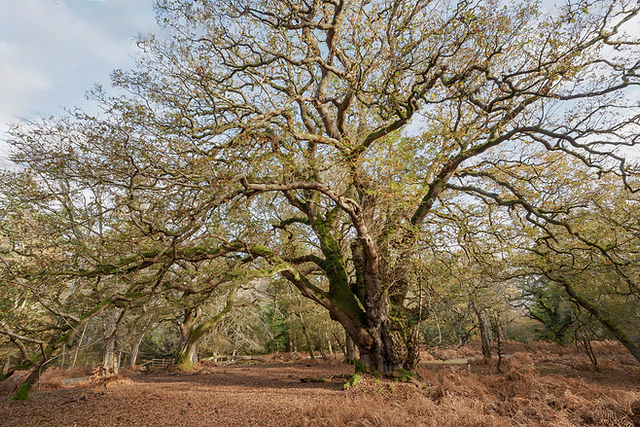
The Undersley Wood Ancient Oak (from the other side)
Tree and shrub species
Appendix: 1A
A personalised A-Z (English > Scientific) reference list of every tree and/or large shrub species that has been specifically identified as occurring in the general habitats covered by the local woodland site articles 1.1a - 1.1c.
Broadleaved
Ash
Beech
Birch (undefined)
Birch, Downy
Birch, Silver
Blackthorn*
Hawthorn*
Hazel
Holly
Lime, Small-leaved
Maple, Field
Oak (undefined)
Oak, Pedunculate
Oak, Sessile
Rowan
Spindle*
Sweet Chestnut
Wild Service Tree
Yew
Fraxinus excelsior
Fagus sylvatica
Betula spp.
Betula pubescens
Betula pendula
Prunus spinosa
Crataegus monogyna
Corylus avellana
Ilex aquifolium
Tilia cordata
Acer campestre
Quercus spp.
Quercus robur
Quercus petraea
Sorbus aucuparia
Euonymus europaeus
Castanea sativa
Sorbus torminalis
Taxus baccata
Coniferous
Douglas Fir
Juniper
Larch (undefined)
Larch, European
Larch, Japanese
Pine (undefined)
Pine, Corsican
Pine, Scots
Spruce (undefined)
Spruce, Sitka
Spruce, Norway
Western Hemlock
Western Red Cedar
Pseudotsuga menziesii
Juniperus communis
Larix spp.
Larix decidua
Larix kaempferi
Pinus spp.
Pinus nigra
Pinus sylvestris
Picea spp.
Picea sitchensis
Picea abies
Tsuga heterophylla
Thuja plicata
* species that may occur as either a large shrub or growing as a small tree
Additional species that occur in the New Forest riverine and bog woodland habitats:
Alder
Alder Buckthorn*
Dogwood*
Grey Willow (Sallow)
Wild Privet
Alnus glutinosa
Frangula alnus
Cornus sanguinea
Salix cinerea
Ligustrum vulgare
Some other common trees and shrubs that have not featured in any of these articles:
Aspen
Elder
Elm
Crab Apple
Goat Willow
Guelder-rose
Hornbeam
Horse Chestnut
Sycamore
Wayfairing-tree
Populus tremula
Sambucus nigra
Ulmus spp.
Malus sylvestris
Salix caprea
Viburnum opulus
Carpinus betulus
Aesculus hippocastanum
Acer pseudoplatanus
Virburnum lantana
Ground-covering and field layer species
Appendix: 1B
A personalised A-Z (English > Scientific) reference list of the various ground-covering and typical field layer species that have been identified as occurring in the general habitats covered by articles 1.1a - 1.1c.
Bracken
Bramble
Butcher's Broom
Honeysuckle
Rhododendron
Pteridium aquilinum
Rubus fruticosus
Ruscus aculeatus
Lonicera periclymenum
Rhododendron ponticum
Ground flora known to occur in Garston Wood (including species not previously mentioned)
Birdsnest Orchid
Bush Vetch
Common Cow-wheat
Common Dog-violet
Common Spotted Orchid
Common Twayblade
Corn Mint
Dog's Mercury
Dusky Cranesbill
Early Purple Orchid
Greater Butterfly Orchid
Hedge Woundwort
Primrose
Sanicle
Solomon's-seal
Sweet Woodruff
Toothwort
Tormentil
White Dead-nettle
Wild Angelica
Wild Basil
Wild Garlic (Ramsoms)
Wood Anemone
Wood Spurge
Yellow Archangel
Neottia nidus-avis
Vicia sepium
Melampyrum pratense
Viola rivinana
Dactylorhiza fuchsii
Neottia ovata
Mentha arvensis
Mercurialis perennis
Geranium phleum
Orchis mascula
Platanthera chlorantha
Stachys sylvatica
Primula vulgaris
Sanicula europaea
Polygonatum multiflorum
Galium odorartum
Lathraea squamaria
Potentilla erecta
Lamium album
Angelica sylvestris
Clinopodium vulgare
Allium ursinium
Anemone nemorosa
Euphorbia amygdaloides
Lamiastrum galeobdolon
Ground cover, vascular plants and mosses recorded from pasture woodland in the New Forest
W15: Beech and Oak woodlands in herb-poor, but moss-rich areas with strongly acidic soils:
Bracken
Butcher's Broom
Honeysuckle
Rhododendron
Wavy Hair-grass
Creeping Soft-grass
Purple Moor-grass
Bilberry
Common Cow-wheat
Wood Sorrel
Pteridium aquilinum
Ruscus aculeatus
Lonicera periclymenum
Rhododendron ponticum
Deschampsia flexuosa
Holcus mollis
Molinia caerulea
Vaccinium myrticullus
Melampyrum pratense
Oxalis acetosella
Bryophytes are significant in many locations, composed of mixed moss mats where Dicranum majus is the prominent component, including, but not restricted to:
Bank Haircap
Broom Fork-moss
Greater Fork-moss
Hart's-tongue Thyme-moss
Silky Forklet-moss
Slender Mouse-tail Moss
Swan's-neck Thyme-moss
White-moss
Polytrichum formosum
Dicranum scoparium
Dicranum majus
Plagiomnium undulatum
Dicranella heteromalla
Isothecium myosuroides
Mnium hornum
Leucobryum glaucum agg.
W16: Oak, Birch and Pine woodlands in areas with strongly acidic soils - very poor ground flora:
Bracken
Rhododendron
Pteridium aquilinum
Rhododendron ponticum
NB. typically lacking the distinctive moss mats found in the Beech and Oak stands noted above.
W14 & W11/10a: Beech and Oak woodlands on less acidic (mesotrophic) soil - herb poor:
Bracken
Common Bent
Common Dog-violet
Field Cow-wheat
Heath Bedstraw
Tormentil
Wood Sorrel
Pteridium aquilinum
Agrostris capillaris
Viola riviniana
Melampyrum arvense
Galium saxatile
Potentilla erecta
Oxalis acetosella
Bryophytes can still be significant in some areas, composed of moss mats not dissimilar to those detailed above for W15, but with Dicranum majus being absent or rare, having been replaced by Thuidium tamariscinum:
Common Tamarisk-moss
Silky Forklet-moss
Bank Haircap
Swan's-neck Thyme-moss
Thuidium tamariscinum
Dicranella heteromalla
Polytrichum formosum
Mnium hornum
NB. in these woodlands, the characteristic Wavy Hair-grass [Deschampsia flexuosa] of W15 & W16 is typically replaced by Common Bent [Agrostris capillaris].
W14 & W11/10b: Beech and Oak woodlands on less acidic (mesotrophic) soil, similar to above, but with spring vernal species:
Bluebell
Wood Anemone
Wood Sorrel
Hyacinthoides non-scripta
Anemone nemorosa
Oxalis acetosella
Bryophyte moss-mats are well-developed in these woodlands, but lacking certain species noted above that are more suited to the strongly acidic soils of W15.
W14/W8b: Typically Beech, but often Ash or Oak dominated woodlands above the floodplain on damp, base-rich, flushed soils :
Bluebell
Common Dog Violet
Creeping Jenny
Enchanter's Nightshade
Lesser Celandine
Lords-and-ladies
Pignut
Primrose
Sanicle
Wood Anemone
Wood Melick
Wood Sorrel
Wood Spurge
Common Bent
Creeping Bent
Tufted Hairgrass
Hyacinthoides non-scripta
Viola riviniana
Lysimachia nummularia
Circaea lutetiana
Ficaria verna, formally Ranunculus ficaria
Arum maculatum
Conopodium majus
Primula vulgaris
Sanicula europaea
Anemone nemorosa
Melica uniflora
Oxalis acetosella
Euphorbia amygdaloides
Agrostris capillaris
Agrostis stolonifera
Deschampsia cespitosa
Bryophytes are sparse compared to the more acidic communities, and are largely represented here by:
Bank Haircap
Striated Feather-moss
Polytrichum formosum
Eurhynchium striatum