Small World Discoveries
by Tony Enticknap - tickspics
Focusing on insects, arachnids, fungus and other small nature subjects from East Dorset and the New Forest ...
ARCHAEOGNATHA | Bristletails
Not to be confused with the much smaller two-tailed dipluran bristletails that are covered within the 'cryptozoa community' section, the three-tailed or jumping bristletails as they are also known, as featured here, are primitive, wingless insects in the subclass APTERYGOTA.
They are a poorly recorded group, represented in Britain by just seven species in three genera which are all placed within the Machilidae family. However, a bit of research quickly reveals that one of these species Dilta saxicola has only been found in Ireland and another, Trigoniophthalmus alternatus (Cave Bristletail) is very rare by nature of its habitat. A further species Dilta chateri (Chater's Bristletail) is only known from South Wales, and Petrobius brevistylis (Western Sea Bristletail) seems to be pretty much confined to a small handful of locations in the west country and South Wales.
Within my general area of Dorset (VC9) and South Hampshire (VC11) only three species occur.
Notwithstanding the fact that many individuals will go unrecorded, the most frequently observed species locally appears to be Petrobius maritimus (Sea Bristletail) although, that said, there are only a dozen or so confirmed records from Dorset all of which are from Portland and, at the time of writing, none at all from South Hampshire. It mainly occurs in rocky coastal areas above the high-water mark and, although in theory it could be confused with the previously mentioned Western Sea Bristletail, it is otherwise easily recognised as it has long antennae that well exceed the body length.
The two species that could be found inland are Dilta hiberernica (Southern Bristletail), the common name of which is a bit misleading as it has been observed as far north as Yorkshire I believe, and Dilta littoralis (Heathland Bristletail). Checking all the available distribution data from both the NBN Atlas database and iRecord I cannot find records of the former from Dorset and very few records for the latter from either Dorset or South Hampshire.
For me, it just goes to show that very few people actively look for small species like these and, possibly, rarely take photos even if they do find them. Although I'm not so sure I could find Dilta littoralis again easily as the two individuals featured below were chance encounters on my local heath in an area I know very well, but had no idea that they were there. Perhaps I should go back and have a look as they were in a small colony, which hopefully is established. Yet, with Dilta hibernica, I think that despite only representing the species here at the moment with three rather similar photos, but not the same individual as they were taken a few days apart in different areas of the forest, that I probably could find them again without too much problem.
All of the British species have similar appearance with a greyish to brownish colouration, and scales that produce a variable mottled pattern. They're typically around 10-11mm long excluding the 'tail', although the two Petrobius coastal species average a tad larger at 13-15mm. The body is elongate and somewhat cylindrical, with a pronounced humped thorax; the head bears long, multi-segmented antennae and large compound eyes plus three ocelli (the arrangement of which helps to determine the genus); and the 'tail' consists of a long central filament and a pair of shorter cerci.
They feed on algae, lichen, mosses and other plant debris, and although they're mainly nocturnal, they can occasionally be found by day in woodland leaf-litter or more likely hidden away under stones or lying deadwood. But, if you do disturb them, don't be surprised if they disappear very quickly as they can run surprisingly fast and can jump many times further than their body length. They are very well-camouflaged and could easily be overlooked, but as they rarely sit still for long, they usually give their presence away by moving. The only problem, is that once they start moving, it's probably too late to try to photograph them.
Dilta littoralis (Heathland Bristletail)
Silvery-grey to greyish brown with some darker markings; inland and coastal heathland, and grassland.
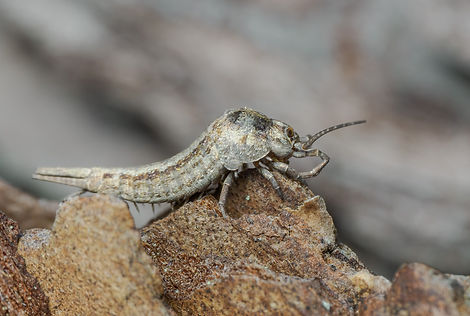


Holt Heath, Mannington, East Dorset | Dec.23
(found on an open elevated area where there was evidence of tree-cutting and a fair amount of bark fragments)
Dilta hibernica (Southern Bristletail)
Superficially similar in both size and general appearance to Dilta littoralis, but typically darker with reflective brown, green and bluish tones; occurs in varied inland and coastal habitats, and the more likely species to be found in wooded areas.


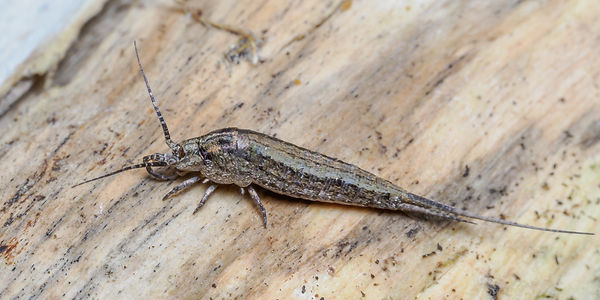
Ringwood Forest, Verwood, Hampshire | July and Aug.25
(both of these individuals were found and photographed on rotting deadwood in coniferous woodland)
Created Sept.25 | updated - (v.1)