Small World Discoveries
by Tony Enticknap - tickspics
Focusing on insects, arachnids, fungus and other small nature subjects from East Dorset and the New Forest ...
Soil organisms
Following the brief explanation and introduction to the cryptozoa on the previous page, I now want to take a reasonably detailed look at some of the species that can be found in the associated microhabitats, starting here with a series of articles that focus on soil organisms that have not been featured elsewhere on the site; then in part two, a broader look at life on the forest floor in general to try to understand how these creatures actually manage to survive and live together. And finally, at some point in the future, I'd like to learn more about the saproxylic invertebrates that depend on dead and decaying wood for at least part of their lifecycle.
5.1: Categorisation of organisms
5.3: Mermithid Nematodes
5.4: Symphylans
5.5: Diplurans
5.6: Other soil mesofauna
5.7: Nymphs, juveniles and 'pygmy' forms
Categorisation of organisms
5.1 (v.1)
Before looking at any of the individual species that I want to feature in this series of articles, it's useful to have an understanding of some of the collective terms that are now being used to describe and categorise different groups of invertebrates and whether they have a specific meaning.
Of particular relevance here are the names used in scientific papers relating to soil biodiversity where species are usually referenced and graded by their physical size rather than their taxonomic classification.
The smallest are the microfauna which, by definition, are microscopic creatures like nematodes, rotifers, tardigrades and tiny mites that are outside the scope of these articles. Moving up in scale, those species with a body width from 200µm to 2mm, such as springtails, mites, pseudoscorpions, diplurans, proturans, enchytraeids, some tiny spiders and and any really small insects are categorised as mesofauna. Larger spiders, harvestmen, centipedes, millipedes, woodlice and most insects fall into the third category, macrofauna.
Simple, until you try to place species that don't quite fit the criteria or where related species would need to be separately defined if, for example, one was marginally larger than the other, which could even apply to the male or female of the same species. For this reason, many authors adopt a different and more practical approach where the term mesofauna is used for any species up to 10mm long. This arrangement incorporates more insects, such as ants and many small beetles, as well as a larger range of spiders and harvestmen, bristletails etc., in addition to woodlice and the smaller millipedes and centipedes that would otherwise be regarded as macrofauna.
There's also a difference of opinion when macrofauna becomes megafauna. In older literature, the term megafauna was applied to species that had a body length over 20mm, but in more recent works specifically relating to invertebrates, macrofauna includes some of the previously mentioned groups where certain species may grow to as much as 80mm, notably millipedes, centipedes and earthworms.
Another approach uses the term micro-arthropod for all micro and mesofauna, and macro-arthropod for all the other species apart from earthworms, enchytraeids and gastropods, which are simply listed as 'other invertebrates'. This simplified method of categorisation has no value in respect of the organisms featured here, but is useful when referring to species in a broader sense.
Annelid segmented worms
5.2 (v.1)
I'm not going to delve too deeply into the classification and taxonomic arrangement of these species as, quite literally, it's a can of worms that can be difficult to understand. In simple terms, the phylum Annelida includes various types of segmented worms, characterised by their soft, elongated body, which is divided into ring-like sections. There are three primary groups: earthworms, marine worms and leeches.
The interest here are the earthworms, class Clitellata which have a saddle-like reproductive organ called the clitellum towards the head end of the body; subclass Oligochaeta including the terrestrial earthworms of the order Crassiclitellata, and the small Enchytraeida 'pot worms'.
Earthworms
5.2a (v.1)
I readily admit that the thought of spending time grubbing around for a few worms to photograph to support this article didn't instil me with much enthusiasm, which is obviously why they haven't been previously featured. My initial plan was to include a brief summary account with a couple of photos and then move on to more interesting subjects but, as is so often the case when you start researching new species, you get drawn in, which is what's happened here.
I was also mindful of the important role that earthworms play in recycling and maintaining soil fertility so, rather than being a short article as originally intended, I've taken the time to find as many of the more common species that I can so that they are properly represented.
In Britain there are only thirty or so native species that can be found living in natural habitats and, apart from a couple that are extremely rare, they are all classified in the Lumbricidae family. Now you'd think that with so few species it would be reasonably easy to identify them but, unfortunately, it's not, as some of the important features are only visible under a microscope. However, knowing which species could be found in certain habitats and situations is certainly a good starting point, and together with the general appearance, colour and length, albeit variable, should narrow the options.
But, to get to a likely species you need to have some reasonably detailed photos showing the position of the clitellum, which is the slightly bulged saddle towards the head end that normally starts on or beyond segment 23. If the clitellum is not present, or only barely visible, then the individual in question is almost certainly an immature juvenile worm that cannot be identified.


Four different specimens, the first of which was found on the ground under a large log, the other three under loose bark.
The habitat, colour, size and certain other features might suggest a possible species, but none have a developed clitellum,
so they're all immature (juvenile) worms that cannot be identified. In fact, from my limited experience, I'd say that I've
probably found at least twice as many juveniles compared with fully mature adults.
The clitellum is usually raised on the dorsal surface of the body, but more or less flush on the underside. Sometimes it's very prominent whereas other times, particularly when the worm is stretched, it can be difficult to determine where it actually starts and finishes. Its precise location though is important as it varies species to species and, after general appearance, is the first specific feature that you should check. It should be a simple case of counting the number of body segments back from the head, but that's not always as easy as it sounds so it's useful to have different photos to refer to as even small changes in the angle of view can help to reduce reflections, thus making the segments easier to count.
Ideally, you should also have a good view of the head to determine whether it's tanbylobic (figs.1a & 1b) or epilobic (fig.2) related to where the head-line of the prostomium ends in relation to the second segment; then whether the body setae beyond the clitellum are closely (fig.3) or widely (fig.4) paired; but these details can be tricky to capture when photographing a free-roaming individual. And even more difficult if not impossible with the location and form of the TP as noted below.
The upshot is that if you want to confirm the species without physically collecting the specimen you would need to temporarily relocate it so that these details could be photographed, in a tray perhaps, but I'm not particularly interested in doing that and am quite happy labelling my photos as 'undetermined', or 'possibly', 'likely' or even 'probably' based on the quality of photos and information available.
So what's the TP - well, apart from a few exceptions, such as Dendrobaena octaedra and Octolasion cyaneum which can reproduce parthenogenetically, most British earthworms are cross-fertilisation hermaphrodites with male and female sexual organs. The male sexual pore(s) are typically located on the ventral side of segment 15, or sometimes on, or spreading to, the segment either side. They're variable in terms of form and size between species, usually appearing as a tiny slit or a pair of small lips, but barely visible in photos unless pronounced or swollen (fig.5) when the worms are breeding. It's a useful feature, but is not generally considered as an important identifying character of a species. However, during mating the worms obviously need to carefully position themselves so that sperm can be exchanged; a process that is aided by the production of mucus from an organ called the tubercula pubertatis (TP) located on the lateral underside of the clitellum, which effectively binds the worms together. The TP has various markings, swellings or lumps that together with its precise location is one of the most important identifying requirements and, as such, needs to be checked under a microscope.
In practice, most species can probably be identified from good photos without specific reference to the TP but, certainly for official recording purposes, microscopic inspection is normally required.
Earthworms are separated into three clearly defined ecological groups based on their lifestyle and where they live in the soil. The first group are the anecic species that live in deep vertical burrows and, apart from a couple of exceptions, are very unlikely to be seen other than at night when they emerge to feed on organic matter. They are typically much larger than any of the other species and are usually dark red or purplish to brownish red to almost black in colour.
Although primarily associated with farmland and grassland areas, there are two species that can occasionally be found on the surface in woodlands. The most likely is Aporrectodea longa, informally known as the 'black-headed worm', which is a sizeable but relatively slender species, around 90-170mm long when extended. The other is the common garden 'lobworm' Lumbricus terrestris, which often occurs in lawns where it casts ingested soil on the surface, but can also be encountered in woodlands where it might be discovered under larger pieces of deadwood. It's a large, stout species that's very variable in size ranging from 100-250mm long, but possibly up to 300mm or more.
Anecic deep-burrowing earthworms


Fig.1a
Aporrectodea longa
Two specimens photographed in different locations, both spotted emerging from soil after being disturbed;
of similar size around 130-150mm long, clitellum (28-35/36), epilobic head and closely paired setae clearly visible

Fig.5

Fig.3
Lumbricus terrestris
Found under a large cut log in open woodland; a large and chunky specimen, close on 200mm long, clitellum (32-37)
and very visible male pores on segment 15, tanylobic head and closely paired setae; slightly flattened tail
Woodlands are known to have a much greater variety of species than any other habitat, yet very few are likely to be found through casual observation or chance sightings, so you need to have some knowledge about the different microhabitats where they might be encountered. Fortunately in this respect, there are a couple of interesting and informative scientific papers specifically relating to earthworms that occur in and around deadwood that, when coupled with the excellent AIDGAP key, gave me everything I was looking for to compile a list of the species I might find locally.
The primary group are the epigeic surface-dwelling species that could be found on the forest floor beneath humous or under deadwood or, in some cases, actually on or within rotting wood, under bark, or even on mature standing trees. These worms do not form burrows and consequently tend to be a little smaller and more active than many of the larger and sluggish species that occur in the soil. They live amongst loose organic material and topsoil, feeding on decaying plant matter and leaf-litter. In order to blend in with their surroundings and provide a degree of protection from UV rays they typically have dark pigmentation in various shades of red often with a gradient along the body.
The species I'd be considering here are Lumbricus rubellus, Lumbricus castaneus and, although far less likely, possibly Satchellius mammalis, or on more acid soils Bimastos rubidus, Dendrobaena attemsi and Dendrobaena octaedra.
More specifically Lumbricus castaneus, Bimastos rubidus, Dendrobaena attemsi and Dendrobaena octaedra have all been well-recorded on rotting wood, especially logs or larger pieces of deadwood that are reasonably well decayed, including old fallen trees where Bimastos rubidus particularly is often found under loose bark. Similarly with Bimastos eiseni which is a known arboreal species that is far more likely to be found off the ground in rotting wood, under bark or even higher up standing trees rather than in litter.
Epigeic surface-dwelling species


Fig.1b


Lumbricus rubellus
Three individuals found on soil and leaf mulch under deadwood; purple-red colour, size around 60-70mm, tanylobic head
and closely paired setae visible; first probably a juvenile so identification unconfirmed, other with clitellum (26/27-31/32)


Fig.2


Bimastos rubidus
Two individuals found together on the underside of a largish piece of rotting deadwood in damp acidic woodland; deep red and
both around 80mm long, presumed the same species although one with a pale bulbous clitellum (26-32), the other red and
less defined (27-33), epilobic head and widely paired setae can be determined to some degree here and in other photos


Fig.4
Dendrobaena octaedra
This specimen was found within accumulated wet leaf-litter in acidic broadleaved woodland; dark red to purplish red between
head and clitellum, 50mm long when stretched and only around 4mm diameter, bulbous clitellum clearly defined (29-33/34),
epilobic head not clear, but widely paired setae are visible

Bimastos eiseni
This individual was found 1.5m or so off the ground under some very loose bark on a dead conifer tree;
around 60mm long, clitellum (27-32/33), male pore on segment 15 and although the tanylobic head and closely paired setae can't be confirmed from either this photo or
a couple of others I have, the microhabitat, general appearance, colour and position of the clitellum all point strongly towards this arboreal species.
The final group are the endogeic soil-dwelling earthworms that live in the subsoil and, although they rarely come to the surface, there's always the possibility of unearthing one when rooting around in leaf-litter or in the soil under deadwood. The most likely species would be the 'green worm' Allolobophora chlorotica or possibly the 'grey worm' Aporrectodea caliginosa and, where there's wetter soil, possibly Octolasion cyaneum or Octolasion lacteum. And lastly, which takes the full list to fourteen species, the 'rosy-tipped worm' Aporrectodea rosea although this one is probably only going to be found in exposed soil under leaf-litter.
All of these worms are typically a little larger than those in the previous group, but considerably smaller than the deep-burrowing anecics, such as the two previously featured species Aporrectodea longa and Lumbricus terrestris. Those earthworms have dark colouration, whereas the endogeics generally have very little pigmentation, more often pinkish to bluish-grey, in contrast to the much darker or brighter epigeics.
Endogeic soil-dwelling species


Allolobophora chlorotica - 'green morph'
Found in the garden in wet soil under a large flower pot I was moving, but included here for reference even though it was not
photographed in woodlands as the other species; distinctly greenish with a narrow yellow band towards the head end,
around 60mm long, clitellum (29-37, although hard to determine how far it extends), epilobic head and closely paired setae
Although commonly known as the green worm, this species also occurs as a 'pink morph' preferring drier conditions than
the 'green morph' which is the more frequent form in grasslands and wet woodland


Octolasion cyaneum
This pale, pinkish-grey specimen with a partial lilac-blue line on the upper surface (present in some individuals) and a distinctive
yellow tail was found on wet soil under a relatively large piece of deadwood and, although the clitellum (29/30-34/35) is
barely discernible which suggests it's not fully developed, the general appearance alone looks good for the species.
Of course there's always a chance of finding a much rarer species, but not withstanding the problems in identification, I think it's unlikely as even some of the above species are not particularly common.
Fourteen woodland target species have been listed: x2 anecic deep-burrowing earthworms (both featured), x7 epigeic surface- dwelling species (four currently featured), and x5 endogeic soil-dwelling species (two currently featured).
All are labelled as (unconfirmed) even though I'm as sure as I can be that they have been correctly named.
The six species I've yet to find are: the chestnut red worm Lumbricus castaneus which is usually found in rotting deadwood or under leaf-litter; the small (24-40mm) uncommon, deep red Satchellius mammalis, which lives in litter in base-rich woodland areas; Dendrobaena attemsi which is an uncommon, but locally frequent species in acidic woodland, notable from deadwood soil, but also from rotting wood or under bark; then three soil-dwelling species, the 'grey worm' Aporrectodea caliginosa, common in woodland soil, but rarely in leaf-litter; the 'rosy-tipped worm' Aporrectodea rosea, a so-called common species in neutral to base-rich moist soils; and finally Octalasion lacteum which can occasionally be found in moist under deadwood.
Enchytraeid 'pot worms'
5.2b (v.1)
Enchytraeids are tiny, pale-coloured annelid worms which occur in many different habitats and types of soil, often in great abundance. They are generally very small organisms, typically just a few millimetres long and very slender and, therefore, difficult to spot with the naked eye. Fortunately, from a casual observer's perspective, there are a small number of species that grow to 20mm or even a tad larger, and some of these occur in the same woodland microhabitats as their larger relatives, the earthworms as discussed in the previous account. The smaller species are almost thread-like usually no more than 200-400µm wide, and even the largest forms are only 600-800µm.
The terrestrial woodland species discussed here mainly live in the upper soil layers where organic matter accumulates so may be seen under leaf-litter or on the ground beneath deadwood, but from my experience they're easier to locate and photograph if you can find them in soil clinging to the underside of deadwood, or under damp bark.
In natural habitats like these, it seems more appropriate to refer to them by their scientific name rather than calling them 'whiteworms' or 'pot worms', which is the colloquial name of the species favoured by gardeners. It comes from the Greek enchytraeon meaning 'in the pot', as they were first discovered living in moist flower pot soil.
Like earthworms they don't possess eyes, so instead, have sensory organs that enable them to find their way around and detect food, which is typically in the form of fungal mycelia and bacteria together with some organic matter. These organs are also linked to receptors that sense light, which is why they often start thrashing about when uncovered. In the shade it's fine, but they can become quite frantic if they're suddenly exposed to bright sunlight as they have no protection from desiccation. They always need a degree of moisture to survive and, particularly due to their small size, can dry out very quickly.
The cylindrical segmented body plan is much like other oligochaetes; the anterior (head) end comprising a prostomium with a wide-opening ventral mouth surrounded by the peristomium, and the posterior (tail) end with a post-segmental pygidium and anus. Fully grown individuals usually have somewhere between 20 to 70 segments. The size and colour are very variable even between individuals of the same species; the size primarily determined by age, and the colour, which can vary from being un-pigmented and clear through various shades of diluted white to having a yellowish tinge, is greatly affected by the gut content.


Not surprisingly enchytraeids are an important food source for many small predatory invertebrates especially nematodes, mites, centipedes and certain dipteran fly larvae, as well as beetles and ants.
I'm not sure how many species have now been recorded in Britain as there doesn't appear to be a publicly available list, but I believe it's currently around 60-70 with new species still being discovered. It would have been interesting to have had access to more recording data, but clearly enchytraeids are a specialist group that very few people study as they can only be identified under a microscope by checking minute distinguishing features that can only be seen through a living transparent body.


Although they can't be individually identified, I always like to have some information regarding the species that could be encountered, but in the absence of a list it becomes rather difficult. I have established though that the larger woodland species, in excess of say 15-18mm that you're more likely to find and photograph, are in the Fridericia genus. Other genera, notably Enchytraeus, Henlea, Lubricillus and Marionina also include some larger species, but these genera are mainly associated with compost or aquatic habitats.
Further investigation, cross-referencing species that have been recorded with information published in the 'Guide to European Enchytraeidae', confirms the largest species as Fridericia ratzeli and galba (15-25mm) with the former sometimes reaching 30mm making it the largest, and also the most robust, enchytraeid that you'd find in typical woodland habitat; then Fridericia striata and perrieri (12-20mm); and Fridericia auritoides and bisetosa (12-18mm). Interestingly, three of those species are not on the NBN database even though they were found during a detailed soil organism sampling exercise carried out back in 2008 at a location in the north. In that survey, Fridericia galba and auritoides were also recorded from deadwood as well as soil or litter. At the time, Fridericia auritoides was noted as having no records from either the UK or central Europe, although it had been previously found in Ireland and Denmark. Despite being a newly discovered species (Schmelz, 2003), it is almost certainly far more common and widespread than records suggest. It is also one of very few enchytraeids that has a reference to colour in that it often appears very yellowish, which is quite unusual for these species.


I can't really explain why, but there's something about tiny creatures like these that I find rather fascinating. I think it's because, unlike many larger species, they're not going to suddenly disappear, which means you have time to observe their behaviour. There's also the fact that you're looking at a species that most people would ignore or not even be aware of. Personally I find that aspect alone quite satisfying, especially if I can photograph the subject in such a way that the picture provides a small insight into their world. In many cases that's simply not possible, but there are times when opportunities arise when you can try to capture something a bit different.
Mermithid - insect-parasitising nematodes
5.3 (v.1)
I'd previously noted that nematodes wouldn't be featured here due to their microscopic size, which is true when referring to the vast majority of free-living species that inhabit woodland soil but, as with all large groups like this, there are always exceptions. I've always been aware that there are a few plant-associated species that grow as long as 10mm or so, but I never realised that there was a huge endoparasitic species that spends the adult stage of its life cycle in the ground.
Now when I say huge, I am talking comparatively as there are some giant marine nematodes that are meters long, but when most soil nematodes are invisible to the naked eye, finding one that you can actually see and photograph makes it special.
The species in question is Mermis nigrescens commonly known as the Grasshopper Nematode as the larvae primarily develop as internal parasites of grasshoppers. The adults are rarely encountered, so as I was fortunate in spotting one, I thought it should be featured even though it's not a soil organism in the true sense.
From the little information available, I understand that the adults are more likely to be seen during late spring when the females climb plants to lay their eggs, which will usually end up being consumed by various foraging insects, but especially by grasshoppers. Once inside the host they will hatch with the young nematodes burrowing into the body cavity to feed on the insect's blood. After a few weeks they will have fully developed and, particularly in cases where a number have survived within the same host, will eventually cause the host to die, at which point they will emerge to seek refuge underground in the soil where they will moult into adults. This free-living phase may last some years if conditions allow but, at some point, they will mate so that the process can be repeated. The most important factor is moisture as all nematodes require water to survive, which is why you're more likely to find them in wet woodlands or damp grassland areas rather than drier habitats.
The males are typically around 5-6cm long, but the females can grow to 18cm or more. The individual I found was around 12-15cm, but as it was twisting itself into knots when I was trying to photograph it, it was hard to gauge the actual size. In that respect, I should point out that the photos are deceptive as the body is much slimmer than it looks, threadlike, so despite its apparent size I only noticed it because it was slowly moving. They are creamy-yellow to pale brown colour, with the female having a small reddish-brown spot on its head, which isn't visible here. Unfortunately I was focusing on the tapered end as I thought it was the head whereas it's actually the tail. The head end is rounded and contains a single light-sensitive eye, which moves independently of the body. Another interesting aspect of this species that was very evident when I was observing it, is that the body seems to be moved in sections, slowly and somewhat jerky at times as each section is manipulated and twisted into position.
The following photos show the specimen when first found covered in soil deposits, and then clean and moist as I didn't want it to dry out before being recovered.


Whether its due to the lack of information or just one of those species where an assumption is made, but it is often confused with Gordian or Horsehair Worms which are superficially similar but differ in several respects, which is why they're separately classified within the phylum NEMATOMORPHA, order Gordioidea, rather than an alternative family within NEMATODA.
The biology of these species is not dissimilar except that Gordian Worms are essentially aquatic species and, consequently, would normally be found in water and not in soil. Their body structure is stiffer and more rigid than Mermis nigrescens, and they are much darker in colour, which has given rise to the common name of Horsehair Worm. They are also considerably longer. There are a few different species of Horsehair Worm, whereas Mermis nigrescens appears to be the only British representative of the NEMATODA > Mermithidae family.
Symphylans
5.4 (v.1)
SYMPHYLA is a small group of soil-inhabiting arthropods, taxonomically classed within the subphyla MYRIAPODA where it sits alongside CHILOPODA (centipedes) and DIPLODA (millipedes), which have their own separate sections, and with another small group PAUROPODA (pauropods) which are not currently featured - the systematic arrangement of the MYRIAPODA is explained here in a little more detail.
Symphylans, or symphylids as they are alternatively called, resemble tiny white centipedes, variable in size from just 2mm or so in respect of the smallest forms up to little more than 8mm for the largest species featured here. They have an elongated body comprising a head, lacking eyes, but with relatively long, flexible, segmented antennae that serve as sense organs; and a multi-segmented trunk protected by overlapping dorsal plates; twelve pairs of legs, although the first pair are usually greatly reduced and not visible; and, at the rear end on the final tergite a prominent pair of conical cerci.
They are represented in Britain by just fourteen species in two families, Scutigerellidae and Scolopendrellidae. The former easily distinguished by a roundish head that is distinctly separated from the body, and the latter, by having an oval, slightly elongated head with no apparent separation from the neck.
The Scutigerellidae family includes eight species: five in the genus Scutigerella (four of which are regarded as common, the other rare); two in Hanseniella (only found in hothouses); and a sole, rare species in Neoscutigerella.
The largest and most frequently observed is the woodland symphylan Scutigerella causeyae, which occurs under logs, in deadwood soil, and decomposing forest floor litter and humus, rather than amongst roots on agricultural land like the other members of the genus. In fact, the habitat alone, coupled with the size, up to 8mm or a tad more, but never smaller than 5mm, makes identification of this species almost a formality.
The first pair of legs are developed, although smaller and slimmer, and one segment shorter than the remaining legs and very often hidden in photos. Additionally, and common to all the species in the family, the body consists of fifteen simple, undivided tergites (in old literature referred to as scuta) with inter-tergal areas between; the first tergite being very reduced, with the remainder having rounded or emarginate posterior margins (in respect of Scutigerella causeyae, only slightly emarginate); and with each pair of legs corresponding with a single tergite, apart from the fourth, sixth and eighth pairs that correspond with two adjacent tergites.
With specific regards to the legs, it should be noted that juvenile symphylans only have six pairs, with additional pairs added over several years as they moult and develop, and only when they have the full complement of twelve pairs are they regarded as adults.


Scutigerella causeyae (including a couple of juveniles) - photographed at various locations, including
Horton Wood and Cannon Hill Plantation in East Dorset, and a couple of sites in the New Forest
The Scolopendrellidae family includes six species: two in the Symphyllelospis genus (both regarded as being reasonably common); a solitary rare form in Scolopendrella; and three in Symphylella (all of which are deemed to be widespread and common). The body form is variable with multiple scuta, from seventeen (rather than fifteen in Scutigerellidae) to twenty-two in Symphyllelospis. None of these species exceed 4mm, and none are specifically associated with woodland.
However, the group are so poorly studied with very little reference material other than the original document entitled "a revision of the British Symphyla" (Edwards, 1958) and with hardly any confirmed records, that you probably need to keep an open mind regarding any of the species you find.
Unless you're specifically looking for a particular species in known habitat, I think that there are only a couple that you might accidently encounter from this family being Symphylella isabellae and Symphyllella vulgaris, the former is the largest with a body length of 2.3-4.6mm, and the latter just 2.4-3.5mm. Both species have been historically recorded from Dorset. The other member of the genus, Symphylella hintoni is even smaller at 1.6-2.7mm and, on that basis alone, I would very much doubt that it would be one that I would find. Similarly with the two Symphyllelospis species which are barely 2mm long.
Based on a measured length of just over 4mm, the individual feature below is most likely Symphylella isabellae, but that identity could only be confirmed with microscopic inspection of setae.


Symphylella sp. (confirmed) - likely Symphyella isabellae as noted above
My final comment about symphylans is not about finding or identifying them, which is hard enough, but with the added problem that they're very active, presumably light-sensitive, creatures that have a tendency to very quickly disappear into any available hiding place such as tiny crevices in deadwood or small gaps between soil particles. It's always difficult to appreciate the size of species like this and the logistical and technical problems in trying to take photos when something this small is constantly on the move. So, for anyone reading this that hasn't had the pleasure, just take a close look at the last couple of photos where the specimen was photographed running across fine soil particles that look more like small boulders.
Diplurans
5.5 (v.1)
Traditionally treated as primitive wingless insects within the subclass APTERYGOTA, alongside silverfish and the jumping three-tailed bristletails (separately covered), DIPLURA, commonly known as two-pronged bristletails are now, together with the PROTURA (coneheads) and COLLEMBOLA (springtails), regarded as non-insect arthropods of the class ENTOGNATHA.
My 'systematics diagram' provides a visual representation of the relationship between these groups.
DIPLURA includes around 1000 species separated into three superfamilies and about ten families; the two primary families are Campodeidae, and Japygidae which are earwig-like with simple unsegmented pincers rather than filamentous multi segmented cerci. Unfortunately, the Japygidae are predominantly found in subtropical and tropical regions and do not occur in the UK.
Only twelve species have been recorded in Britain, all of which are in the Campodeidae, Campodea genus.
Diplurans are small, around 3-5mm body length, wingless, species with six legs, long antennae with bead-like segments and a distinctive pair of cerci. The body is elongate, translucent white to pale yellow, with a small, eyeless head, thorax (split into pronotum, mesonotum and metanotum) and a segmented abdomen with ten tergites. The antennae do not have a scape or pedicel as all the segments (antennomeres) have individual muscle connections, such that all segments are counted beyond the articulated head socket.
They live in soil, rotting leaf-litter and other forest floor detritus, and are typically found when looking under deadwood or stones, but they are very light-sensitive and quickly disappear, which together with their tiny size, makes them very difficult to photograph. Another frustration is that, from my experience, it's rare to find a specimen that hasn't got a broken cerci or antennae.


Anses Wood, New Forest | March 23
Campodea agg. - undetermined
Shaves Wood, New Forest | Oct.25
Campodea agg. - undetermined
(broken antenna, and cerci, but with the intact cerci very long)
(an apparent totally tailless individual, which is rather odd)
The British representatives of the family mainly feed on living or decomposing plant matter, fungal mycelia, and dead insects, but some such as Campodea staphylinus have been observed trying to catch tiny soil organisms such as nematodes, enchytraeids, and small mites.
The available data for these species is limited as they are so rarely recorded, but from the information I've been able to find I believe that there are five species that I should be considering locally:
Campodea staphylinus - common and widespread; the most frequently recorded species
3.9-4.6mm; abdominal tergites 6-9 with antero-lateral macrosetae; antennae with 19-22 antennomeres
Campodea lubbocki - rarely recorded, but known from Dorset
3.5-4.2mm; abdominal tergites 1-9 with postero-lateral macrosetae; antennae with 20-23 antennomeres
Campodea meinerti - rarely recorded , but known from Dorset
3.5-4.2mm; abdominal tergites 1-7 (not 8 and 9) with postero-lateral microsetae; antennae with 20-26 antennomeres
Campodea westwoodi - few records, but known from Hampshire
2.0-5.7mm; mesonotum without postero-lateral macrosetae; pronotum with robust postero-lateral macrosetae; antennae with 18-22 antennomeres
Campodea silvestrii - few records, but known from Hampshire
3.9-4.6mm; cerci covered in long, thin macrosetae with thin barbs along distal half; antennae with 19-25 antennomeres
Campodea plusiochaeta - possible, but tiny, just 1.9-2.3mm; the remaining species, notably Campodea lankesteri, fragilis, and giardi have not been recorded locally according to available records
The above information is mainly taken from the old Delaney (1954) RES key, but also with reference to more up to date information provided in a European paper. In some cases, identifying features or even species are questionable so the unofficial view at the moment is to simply record them as Campodea agg.


Anses Wood, New Forest | March 23
Campodea agg. - undetermined
(photographed at the same time as the first specimen, and for
sure the same species; antennae with 22 segments)
Garston Wood, Cranborne Chase, East Dorset | Sept.22
Campodea agg. - undetermined
(cerci with notably stout macrosetae - one cerci broken;
antennae with 22 segments)
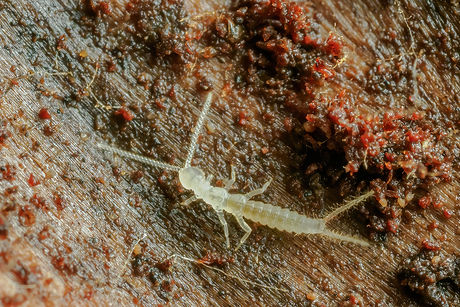
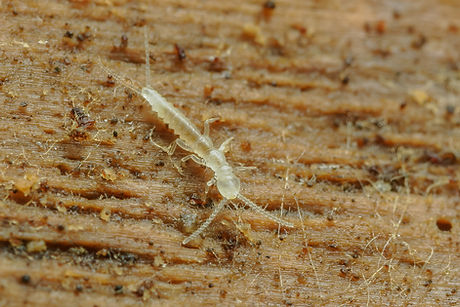
Ringwood Forest, Verwood, East Dorset | Jan.23
Campodea agg. - possibly Campodea staphylinus
(this individual appears to have antero-lateral macrosetae on abdominal tergites 6-9,
which would point to the above species; antennae with 22 segments)


Hillier Garden Woodlands, Romsey, Hampshire | Feb.25
Campodea agg. - possibly Campodea silvestrii
(two different specimens, both with broken cerci, but with macrosetae on the distal half looking particularly long and thin,
suggesting the above species; and also with the antennae having 25 segments, which rules out other species)
Other soil mesofauna
5.6 (v.1)
Of course, there are many other soil-inhabiting creatures that can be found on or close to the surface beneath decomposing leaves and deadwood in addition to the earthworms, enchytraeids, diplurans and symphylans featured above. Whilst the larger more conspicuous species, such as centipedes and woodlice for example, will be covered in the following section regarding life on the forest floor, there are a few smaller species that need to be mentioned in this series of articles even if they have their own separate sections elsewhere on the site.
I'm specifically referring here to the tiny, not quite, but almost microscopic organisms that in the most part go unnoticed unless you're specifically looking for them. The two standout groups are soil mites and springtails, both of which can be extremely numerous where conditions are suitable. And, although much harder to find, pseudoscorpions should also be included as they're of a similar size that puts them in the category of mesofauna.
Although these tiny creatures are much easier to locate and photograph when they're on leaves or wood rather than actually on top of the soil, this is the zone I like exploring especially for mites and springtails as the individual species are typically a little larger than those that live a little deeper in the ground. When working closely in these situations, you'll often spot other really tiny specimens that, in practice, are pretty much impossible to photograph as you quickly loose sight of them, so there's always going to be a limit with regards to the different varieties that can be represented.
The following species have been covered in detail in the main part of the website, so I'm not going to repeat information that's previously been given, but as this page specifically focuses on soil organisms it's worth having a look at the most likely species you'll encounter in these habitats.
Soil mites is a convenient collective term for the terrestrial, non-aquatic species, but if you read through the ACARI section you'll see that the 2000 plus British species which fall into this general category are actually separated into three clearly defined groups - the slow-moving, 'armoured' oribatid soil mites that feed on fungal hyphae and organic matter, which are the primary suborder associated with this type of woodland habitat; then the active mesostigmatans where certain species, such as members of the Pergamasus and Macrocheles genera, will often be seen chasing down suitable prey like nematodes and enchytraeids, but also other tiny mites; and lastly, the prostigmatans which constitutes a large and diverse number of species that use their modified mouth parts to pierce and feed on fluids such as plant sap, but also blood, so some of these species may also be found hunting at ground level, although from my experience far less often than any of
the predatory mesostigmatans.

Eupelops cf.acromius - Oribatida > Phenopelopidae
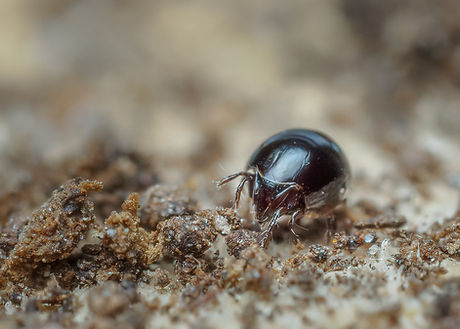
Euzetes globulus - Oribatida > Euzetidae

Parasitinae sp. - Mesostigmata > Parasitidae

Macrocheles submotus - Mesostigmata > Macrochelidae
Springtails, subclass COLLEMBOLA are also separated into three primary groups, in this case orders, but with roughly a tenth of the number of families and not far off that percentage of species. These groups can be broadly described as the soil-dwelling, short-legged, 'plump' and somewhat elongate poduromorphes, which are more often found in the soil or occasionally on the underside of rolled deadwood rather than on the surface; the slow-moving, 'globular' symphypleones, which might be found on the ground, but from my experience are far more likely to be seen on deadwood or low-growing vegetation; and then, the typically larger, 'elongate', surface-active entomobryomorphs that are the most frequently encountered springtails found within leaf-litter and the general habitat we're looking at here. More often than not they will
be from the Entomobrya, Isotomurus, Orchesella, Pogonognathellus or Tomocerus genera.

Tomocerus cf.minor (Thomoceridae)

Orchesella cincta (Entomobryidae)

Orchesella villosa (Entomobryidae)

Entomobrya albocincta (with woodlouse for size comparison)
Pseudoscorpions would be fearful little creatures if they were considerably larger than they are, but they're tiny, averaging little more than 2mm long, and completely harmless unless you're an equally sized or smaller species, such as a mite or springtail. There are less than 30 species in the UK and many of those are either rare or only found in certain areas, and
even when you start considering the more common species there are only a relatively small number that are likely to be seen in woodland soil and leaf-litter. In my area, it would mostly be the common chthonid [Chthonius ischnocheles] or the moss neobisid [Neobisium carcinoides], and possibly, but more dependent on habitat, the dark-clawed chthonid [Chthonis tenuis] and the compost chernes [Pselaphochernes scorpioides]. There are a few others, including the reddish two-eyed chelifer [Roncus lubricus] and Cambridge two-eyed chelifer [Roncocreagris cambridgei] for example, or even one of the arboreal tree species that may ocassionally be found on the ground such as the common tree chernes [Chernes cimicoides], but they're not species I'd expect to find.

Common chthonid - Chthonius ischnocheles

Compost chernes - Pselaphochernes scorpiodes
Nymphs, juveniles and 'pygmy' forms
5.7 (v.1)
Before moving on to the more frequently observed creatures that inhabit the forest floor, I want to finish this section with a rather lengthy article about some of the other tiny species that may be encountered in soil, which despite their diminutive size are not classed as mesofauna in the true sense as they're immature or juvenile species that are still developing, or simply smaller or pygmy forms of typically larger species.
Looking at the photos below it's difficult to see how some of these individuals could be confused, but they're tiny and often well-camouflaged which makes identification in the field tricky. Unless you've got really good eyesight and are totally familiar with all of these species it's easy to initially think they're something different or incorrectly assume that they're a nymph or juvenile when they're actually a small variant species in their own right. When you research some of these smaller forms, particularly those in the second part of the article, you quickly see why they're often over-looked and, therefore, under-recorded, which is why I now tend to photograph pretty much anything I find in soil or on deadwood as you're never sure exactly what it is until you've had a chance to look at it properly.
Starting with insects, here a couple of common examples which include barkfly nymphs, perhaps more often seen clinging on to the underside of deadwood rather than in the soil, which at first glance could be mistaken for globular springtails; and, although larger, Tawny cockroach nymphs that live and develop in soil and which look rather like a mesostigmatan mite. Earwig nymphs are more obvious once they've reached their third or fourth instar stage of development, but if you happen upon hatchlings near a nest site you might imagine they're something different.


Whilst most barkflies are arboreal, living on tree trunks, branches and leaves, some species lay their eggs in the soil or under deadwood, so its not unusual to find nymphs like these at ground level. They're tiny and can easily be mistaken for springtails.
%20-%20Ectobius%20pallidus-2.jpg)
%20-%20Ectobius%20pallidus.jpg)
These small Tawny cockroach [Ectobius pallidus] nymphs are well-camoflaged on soil and at first sight look somewhat like a large meststigmatan mite until you realise they're too big, but it's also just as easy to assume they're a pale species of ground beetle.
%20-%20Forficula%20auricularia.jpg)
%20-%20Forficula%20auricularia-2.jpg)
Immature common earwigs [Forficula auricularia] look much like the adults once they've reach the later stages of development, but if you come across any of the young pale-coloured hatchlings like the one shown above you could think it was something more unusual.
But the bigger problems I find in respect of possible 'confusion species' are with woodlice and myriapods, which is the main reason why I wanted a separate reference point away from the individual species accounts. Each group, woodlice, centipedes and millipedes include pygmy or smaller forms that, particularly in respect of woodlice, could be overlooked, incorrectly mistaken for a juvenile when it's an adult of a smaller species, or indeed the other way round, thinking it might be one of the smaller species instead of considering that it may not be fully developed.
ISOPODA, section Synocheta includes a number of small soil-dwelling woodlice, which are recognised by having antennal flagellum that taper to a point. The most likely species to be encountered in woodlands are trichoniscids of the genera Haplopthalmus and Trichoniscus; the former commonly known as ridgebacks having a continuous body outline and an eye consisting of a single ocellus; and the latter, which are the pygmy woodlice, with a stepped body outline and three ocelli. The common pygmy woodlouse, Trichoniscus pusillus, is a tad larger than the other species in this group at 4-5mm and has a distinctive reddish or purplish-brown colour. The 'confusion species' are Haplopthalmus danicus and Haplopthalmus mengei / montivagus which have a maximum length of 4mm and are off-white to buff coloured; and, but more so, the much under-recorded (due to its size) least pygmy woodlouse, Trichoniscus pygmaeus, which averages just 2-2.5mm. This tiny species is white to creamy white and is very easily overlooked. I'm still trying to find an adult, so the examples below only show juveniles at present - note the large head and six-segmented body with six rather than seven pairs of legs.
Separating juvenile pygmy woodlice has always caused problems in identification apparently, which prompted a note in
the key stating that "juvenile Trichoniscus pusillus always contains some reddish-brown pigment except when very young. Thus, creamy-white specimens of less than 2.5mm in length, with three ocelli forming a tight group on each side of the head, are invariably Trichoniscus pygmaeus".

Common Pygmy Woodlouse - Trichoniscus pusillus
(at nearly 5mm long, with reddish to puplish-brown colouration,
this particular species shouldn't be confused)


Spurred Ridgeback - Haplopthalmus danicus
(smaller at around 3.5-4mm, buff-coloured with a continuous body outline and large single ocellus)
%20-%20Trichoniscus%20pygmaeus.jpg)
Here are two undetermined juveniles - the larger one on the left was around 4mm long and based on size and the hint of reddish pigment is a good candidate for Trichoniscus pusillus; whilst the tiny, barely 2mm long colourless one on the right is clearly very young still with
six pairs of legs, but given the size and general appearance is almost certainly the Least Pygmy Woodlouse - Trichoniscus pygmaeus.
CHILOPODA, order Geophilomorpha includes a couple of small soil centipedes that can be found in my area, namely Schendyla nemorensis and Geophilus truncorum, neither of which grow to more than 20mm long, but with the latter more typically around 12-14mm. Of the two, Geophilus truncorum is probably the more likely species to be found in woodland soil, litter and on deadwood, and from its size alone is relatively easy to distinguish from larger similarly coloured geophilids.
All of the species in this group have the same odd number of legs and trunk segments when immature as they do when they're adults, which in the case of the species I'm likely to see range from 37 to 83 pairs. The situation is the same with the scolopendromorphs, although with those species they always have 21 pairs. However, it becomes more complicated with the lithomorphs as they start out with fewer legs, but will develop to have 15 pairs, so whilst a shortage of legs will determine that the individual is a juvenile, identity of the species can't be taken further.
The Scolopendromorpha comprises just three species in the Cryptops genus. The smallest is Cryptops hortensis and I've photographed many of these centipedes in woodland habitat that are under 20mm long. Cryptops are realatively easy to distinguish (see family account) so they shouldn't be confused.
In the Lithobiomorpha stone centipedes order there are a number of species in the difficult Lithobius genus that are under 20mm long with the smallest likely to be found in woodland being Lithobius microps at just under 10mm, which is the smallest centipede I'm going to see. Others to consider include Lithobius melanops at around 17mm, which occurs in woodland as well as more open spaces such as gardens, and a couple of other much scarcer species I haven't seen, that according to the distribution atlas are possible in my area, notably Lithobius crassipes which only grows to 14mm, and Lithobius borealis which is a tad smaller. Both of these species have been recorded in deciduous woodland, but there are very few records so it's hard to know whether they are truly scarce or just under-recorded. I'm not sure how easy they would be to identify from photos given that all lithobids have fifteen pairs of legs when fully mature so other features have to be more carefully assessed.
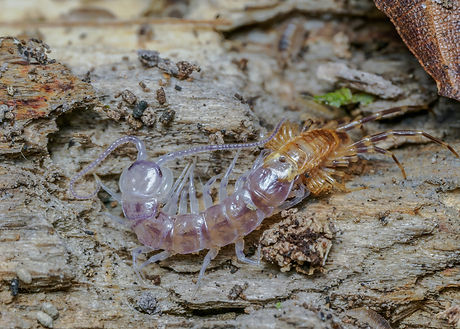
Immature lithobids though are easily recognised by not having the requisite number of legs and trunk segments, but even when they've achieved that stage in their life cycle it can take a further two years or more before they can be regarded as adults as their ocelli and antennal segments will still be growing. During this period they will continue to develop and will moult a further four or more times, with freshly moulted individuals usually having a distinctive violet tinge. You don't often get to witness the process as they're completely defenceless at this stage so they usually hide themselves away, but I was lucky enough to accidently uncover one where the new body was still being pumped out of the split head of the old exoskeleton as seen below.
The important point to note is that lithobids vary greatly in size from 10mm or so up to 30mm in respect of Lithobius forticatus so it shouldn't be assumed that small specimens are simply young stages of larger species.

Geophilomorpha > Geophilus truncorum
(typically 13-14mm long with 37-41 trunk segments, and 20 to 25
times length to breadth ratio giving a good indication of size)

Geophilomorpha > Schendyla nemorensis
(up to 20mm long with 37-43 trunk segments, and seen here with a 'large' 1.5mm Tanaupodidae velvet mite for scale)

Scolopendromorpha > Cryptops cf.hortensis
(this individual was a little under 20mm long and is almost ceratinly the common woodland member of the genus)
.jpg)
Lithobiomorpha > Lithobius variegatus
(this young lithobid is in the process of moulting and normally
would be unidentifiable at this stage, if not for the banded rear legs)

Lithobiomorpha > Lithobius microps
(around 9mm long this rather pale specimen represents
Britain's smallest centipede species)
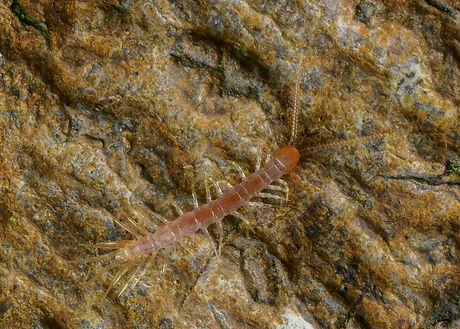
Lithobiomorpha > unidentified young lithobid
(around 12mm long with its full quota of legs, but clearly still in
the process of developing, so a 'first post-larval stadium')
DIPLOPODA includes various small millipedes that could be found in the same woodland habitat as the above species and, from my experience, can be tricky to identify due to the problem of distinguishing and separating immature specimens from adults. It's not difficult when you work through features methodically, but in the field it's certainly easy to make mistakes.
The following examples focus on the small (>12mm) most frequently encountered 'confusion species' that are found in my area. There are a couple of other species that are even smaller, but they are not likely to be misidentified in the same way.
Order Chordeumatida, family Craspedosomatidae
The common medium-large (>20mm) flat-backed millipede Nanogona polydesmoides is distinctive and easily recognised when its fully developed with 30 body segments as opposed to the polydesmid species which have 19 or 20 segments, but confusion may occur with small juveniles that are still developing, such as the individual in the first photo below which is around 10mm and only has 15 or so segments. If it wasn't for the fact that it has eyes, it could be mistaken for Polydesmus except that the members of that genus are blind.
Order Polydesmida, family Polydesmidae
There are a couple of small species in this family, but the one to look out for is Brachydesmus superus which only grows to around 9-10mm and, with reasonable certainty, can be distinguished from the typically larger Polydesmus species by having 19 rather than 20 body segments when mature. But, whilst the small size is an important factor, if you wanted to be absolutely certain that it wasn't a subadult Polydesmus closer inspection would be necessary.
In respect of Polydesmus, and without getting into the nitty-gritty of trying to determine the actual species - where there are four that would need to be considered - you need to check the number of body rings to ensure that the specimen in question is indeed an adult. For example the individual featured below only has 18 rather than 20 body rings and, therefore, is still developing. The segments, or rings as they're known, start with the plate-like collum behind the head, followed by three haplosegments each with a pair of legs, then twelve larger rings called diplosegments that become slightly smaller towards the rear of the animal, each with two pairs of legs (normally fourteen at adult stage), followed by a single legless ring, and finally at the tail end is the telson, also known as the preanal ring, which is counted as the last segment. The final photo shows a tiny polydesmid with just 17 rings that could easily be an immature Brachydesmus superus or a Polydesmus, but there's no way of telling at this stage.
.jpg)
Chordeumatida > Nanogona polydesmoides (immature)
(around 10mm long with only 16 or so body segments and would be unidentifiable if its triangular patch of eyes had been obscured)

Polydesmida > Brachydesmus superus
(tiny, around 9mm long, much the same size as the species on the left, but a fully grown adult with 19 body rings and no eyes)
.jpg)
Polydesmida > unidentified Polydesmus sp. (immature)
(juvenile specimen with 18 rather than 20 body rings and with
the paranota lacking sculpture)
.jpg)
Polydesmida > unidentified species
(this tiny polydesmid with just 17 body rings is probably a Polydesmus, but could just as well be an immature Brachydesmus)
Order Julida, family Blaniulidae
Probably more likely to be found on deadwood rather than on the ground, but Proteroiulus fuscus needs to be included here as it's the smallest woodland centipede, other than Nemasoma varicorne (family Nemasmatidae) which invariably is found under bark. They are very small and slender, averaging around 8-12mm long, and could easily be confused with the following two examples, which are juveniles of larger species.
Order Julida, family Julidae
Featured here are two undetermined juveniles both around 12mm long which, at first glance, look very much like Proteroiulus fuscus although with slightly different proportions, particularly noticeable in the second example. The first thing to note though is that they have a large eye patch rather than in-line ocelli, but looking further it will be seen that the last few segments lack legs, again more clearly seen in the photo of the paler individual, and this feature alone clearly confirms that they're still developing. At this stage they cannot be identified, although the darker of the two could possibly be Cylindroiulus britannicus as it has no obvious telson, and the other is likely to be Tachypodoiulus niger as the juveniles of this species have this light colouration - but the important point here is to recognise them as juveniles and not adults of a smaller species like Proteroiulus fuscus.
The second photo on the right shows a rather cute-looking 'baby' julid that was only 3/4mm long and which is clearly still in the early stages of development.

Julida, Blaniulidae > Proteroilus fuscus
(a tiny, 10/12mm long woodland species)


Julida, Julidae > unidentified juvenile
(a tiny individual, barely 4mm long and the smallest I've seen)

Here are two undetermined juveniles, both around 12mm long with the last few segments of the body lacking legs
(particularly evident in the paler individual on the right) indicating that they are still developing and can't be reliably identified,
although possible candidates were suggested by an expert from the BMIG group as confirmed in the accompanying text above
The above observations regarding 'juvenile v adult identification' of centipedes and millipedes prompted me to check a few facts regarding the life cycle of these species as I couldn't remember some of the detail. That exercise produced some interesting information that isn't readily available so I've summarised the key points as an accompanying page to the Myriapoda family and species accounts entitled Post-embryonic development, which can be directly accessed from here.
It's a useful reference document that helps make sense of some of the information noted above.