Small World Discoveries
by Tony Enticknap - tickspics
Focusing on insects, arachnids, fungus and other small nature subjects from East Dorset and the New Forest ...
ACARI | Prostigmata
This large and diverse group of mites includes an interesting mixture of species that vary greatly both in terms of size and body form, as well as lifestyle and feeding habits.
Whilst the majority of species you'll be able to find and possibly photograph will have a body size in the region of 0.5-2mm, there are many that are smaller that will go unnoticed. But there are also a few that are certainly bigger, notably members of the Trombidioidea, collectively referred to as 'velvet mites' where some species can grow to 8-10mm, possibly more.
Their general appearance is very variable with the smaller forms typically having an oval or elongate, relatively plain-coloured body, whereas the larger, conspicuous species are generally more bulbous, often wide-shouldered and are usually brightly coloured. They are mostly soft-bodied, weakly sclerotised mites that, in part, are distinguished from mesostigmatans by their legs, as the two pairs at the front are separated from the rear pairs such that there's a distinct gap between pairs II and III, whereas in Mesostigmata pairs II, III and IV are all next to each other. The segments also differ, tending to be quite uniform among the Prostigmata, only narrowing slightly at the joints, and with fused coxae, compared with the more variable, tapering, freely-moving structure seen in Mesostigmata.
Although difficult to see, most species have a tracheal system with spiracle openings, known as stigmata, located either near the base of the mouthparts or around the front dorsal edge of the idiosoma, hence the name Prostigmata. They usually, but not always, have eyes and, as noted below, have mouthparts adapted for fluid feeding.
I've added some brief notes in respect of the ecology or lifestyle of certain family groups, but I deliberately haven't gone into much detail as I don't have the knowledge, or indeed the space. Most of the species featured here are regarded as soil mites as they are mainly found at ground level in the soil or litter, or under deadwood and stones, but some are arboreal occurring on trees or shrubs, in mosses and lichen or under bark. They're mainly predatory mites that feed on a variety of small arthropods, but there are also plant-feeders and a few fungivores, and even some that exist on waste and decaying organic matter. And then there are the parasitic species that are associated with a wide range of hosts from slugs and snail to various invertebrates, and some animals, and even one particular group that start life as a parasite but then change their feeding habits when they're adults. The list goes on, and similarly with the plant parasites that can cause variable amounts of damage to a wide range of host species, whether harmless leaf discolouration or gall-inducing to being serious pests of commercial crops. And, if that wasn't enough variety, there are also a large number of aquatic species as mentioned below that are not covered.
In one way or another, their feeding habits provide nutrition derived from consuming liquid in whatever form it takes and, as such, the mouthparts are variably modified for piecing and sucking, rather than tearing or chewing. Many have the chelicerae fused into a puncturing stylophore, whilst others may have different adaptions for sap-sucking. Accordingly, it's not uncommon to see the Prostigmata referred to as 'sucking mites' thereby retaining the more generic 'predatory and parasitic mites' title for the Mesostigmata fauna.
A final observation before starting to look at the various subgroups and families is that most of the more familiar or conspicuous species have common names, such as 'whirligig mites', 'velvet mites', 'spider mites', 'concrete mites', and so on, that can often lead to confusion. I've been careful in my use of these names and have, hopefully, made the correct references where necessary. The more usual collective names, as in 'gall mites' or 'water mites' for example, are better defined and rarely cause a problem.
The British list includes just over 1000 recognised species that are spread across 70 families, which are rather daunting numbers for a casual observer to get to grips with but, when those families are correctly segregated and broken down, the actual number that are likely to be seen and hopefully photographed becomes far more manageable and a lot easier to understand.
The first step is to note that there are four infraorders; Anystides which includes two primary divisions (hyporders), Anystina and Parasitengona; Eleutherengonides, which is also separated into two groups Heterostigmatina and Raphignathina; Eupoides that has no higher-level taxon divisions; and lastly Lapidostommatides, which comprises just one well-sclerotised species. We can now look at each of these subgroups to focus on the superfamilies and families that we need to consider.
Anystides - Anystina is a small division comprising just two families, Anystidae as featured below and Hydrovolziidae; whereas Parasitengona is a large group that includes over thirty families as explained in the following superfamily writeups. However, twenty-two of these families that collectively include around 170 species are in the Hydrachnidiae 'water mites' subcohort and, consequently, can be ignored as they don't come under the category of soil mites.
Eleutherengonides - without going into detail, I don't think that there's much interest here from a photographer's point of view. I could be wrong, but at the moment I'm only able to feature a single species from the Tetranychidae family.
Eupodides - there are fourteen families in this hyporder that are separated into five superfamilies, four of which are covered here to some degree. The Halacaridae family includes around 70 species of 'marine mites' and, as with the Hydrachnidiae,
is excluded.
The number of species to consider is now considerably reduced, as are the families and although I'm only able to represent
a few at present, I'm hopeful that in time I'll be able to build on this initial collection.
In a similar format to that used in the other groups, I've followed the systematic (hierarchal alphabetical) listed order - see the final introductory paragraph on the Oribatida page for further information - which, for convenience, are grouped into eight sections:
1) Anystides > Anystina > Anystoidea > Anystidae (family)
2) Anystides > Parasitengona > Erythraeoidea (superfamily)
3) Anystides > Parasitengona > Trombidioidea (superfamily)
4) Eleutherengonides > Raphignathina > Tetranychoidea (superfamily)
5) Eupodides > Bdelloidea (superfamily)
6) Eupodides > Eupodoidea (superfamily)
7) Eupodides > Eryophyoidea (superfamily)
8) Eupodides > Tydeoidea (superfamily)
The associated notes have been compiled from numerous bits of information that I've accumulated during my research, much of which has been extracted from various scientific papers. In all respects I've been careful in making sure that it relates to species that I might be able to find locally. The references made to the number of species within each family is based on the latest information available from the Soil Biodiversity UK website and the current UK Acari Taxonomy list, to which I've kindly been granted access.
ACARIFORMES > Trombidiformes > Prostigmata
Anystides > Anystina > Anystoidea > Anystidae
The Anystidae includes long-legged, soft-bodied, fast-moving species, that in some larger classification systems are split into two subfamilies Anystinae and Erythracarinae. Only nine validated species have found their way onto the current British list and, although they're not officially placed into subfamilies, they can still be treated as two separate groups. The nine species are placed in four genera; Anystinae > Anystis with four species that have a short, broad idiosoma; and in the Erythracarinae, five species > Chaussieria (2), Erythracarus (2) and Tarsolarcus (1) which have a more elongate appearance as the idiosoma is longer than broad.
Unfortunately I'm not able to represent any of the species in the second group and can't find any records or, indeed, much information about them other than Chaussieria maritima is an inter-tidal mite that has been recorded in the South West.
The situation with Anystis is much the same as the only publicly available records relate to either the genus or the 'type species' Anystis baccarum. Personally, I can't see how they can be reliably identified from photos and, given there's virtually no information regarding the other species, it's probably a safe bet to assume that all of the individuals featured here are the common and widespread form.
Members of the genus are generally described as moderately large (500-1500µm) mites with a broad, but relatively short, almost trapezoidal-shaped body, with a more or less kidney-shaped prodorsal shield, and two pairs of lateral eyes that are located just behind the shield; somewhat variable in colour, but mainly bright orange-red, sometimes darker and occasionally pinkish to yellowish; the legs are longer than the body and of similar length, and are closely attached allowing the mite to change direction very quickly, which has resulted in the common name of 'whirligig mite'.


Anystis baccarum is a well-studied species with a detailed updated description but, understandably, with most of the defining characters only identifiable through close inspection. However, there are a couple of features were mentioning. Firstly, the prodorsum is smooth without ornamentation as seen in Anystis salicinus, and with a more distinct kidney-shape that is well rounded anteriorly and indented posteriorly. The shield bears two pairs of long setae and a pair of sensilla. A further pair of sensilla are found on the anterior margin of the idiosoma. The opisthosoma has eight pairs of setae. Some of these features might be visible in photos, but in practice it's very difficult to get well-focused photos with that level of detail of species that are almost constantly on the move.
One final bit of information relates to the interesting fact that this particular species apparently has no males and, therefore, reproduction is by parthenogenesis - from the ovum without fertilisation. In gravid females the maturing eggs can often be seen through the outer layer of the body.


Location / habitat notes: I've seen Anystis in various places including in the garden, but most of the individuals featured here were photographed in wooded areas, mainly at a couple of different broadleaved woodland sites in the New Forest, but also in coniferous woodland in Ringwood Forest. In most cases they were found either under lying deadwood or on fallen trees.
ACARIFORMES > Trombidiformes > Prostigmata
Anystides > Parasitengonina > Erythraeoidea
The Parasitengonina hyporder (cohort) is a large and diverse assemblage of species that in larger classification systems is split into four primary groups (subcohorts) each containing a variable number of related subfamilies. The British fauna is more limited and doesn't need to be classified to that extent and, as such, we only use the intermediate (subcohort) ranking of Hydrachnidiae for the six 'water mite' superfamilies. The remaining parasitengonine families are placed either in the Erythraeoidea superfamily as represented here, or the Trombidioidea as covered in the following section.
The Erythraeoidea includes two families Erythraeidae with near on 40 species in 6 genera, and Smarididae with just two species. I can't find much information regarding most of these species and, although I'll keep an open mind, I'm doubtful that I'll be able to add much more to this section.
Balaustium murorum is a familiar and well-studied species that typically occurs in early spring, appearing on sunny surfaces of mainly man-made concrete and stone structures where it primarily feeds on windblown pollen particles. They are tiny, fast-moving mites, that are easily seen as they have a bright red body. They are found all over the world very often living in temperatures far exceeding those experienced in Britain. Whereas most species would actively avoid direct sunlight, these mites seem to be oblivious to the heat and can often be seen on surfaces that are too hot for human touch. The red pigment protects the mite in some way, but there appears to be different views and opinions.
They are commonly known as 'concrete mites' or 'sidewalk mites' depending where you live but if you search the internet, you'll almost certainly find conflicting information as they are regularly misidentified or misnamed as 'clover mites', 'chiggers', 'small velvet mites' or even 'whirligig mites'. The generic term 'little red mites' is also used a lot, as is 'red spider mites', which is particularly misleading as that's the common name for the tiny plant-feeding 'pest' mites in the Tetranychidae family. This type of misinformation has probably resulted in the killing of many of these totally harmless little mites that are regularly found in gardens. They mostly feed on pollen as previously noted, but they are also predators of various tiny arthropods that may actually be 'pest' species.

Erythraeidae > Balaustium murorum

Erythraeidae > Balaustium murorum
There are a number of species in the wider Palearctic region that are difficult to separate so they are usually treated as groups, Balaustium murorum that may include eight or possibly more species and Balaustium araneoides that, as far as I can see, is more limited, but still covers three or four species. The British list seems to confirm that we have one defined species in Balaustium murorum and possibly three that are linked to Balaustium araneoides and, as such, we treat the latter as a group.
I was interested to read that Balaustium araneoides was a coastal species that could be found on rocks and boulders and, indeed, on my first attempt I discovered quite a few alongside the slipway at Kimmeridge Bay, but strangely only on one side even though the habitat on the other side appeared identical.

Erythraeidae > Balaustium araneoides (group)

Erythraeidae > Balaustium araneoides (group)

Erythraeidae > Balaustium murorum

Erythraeidae > Balaustium araneoides (group)
I'd previously understood that they were very similar and, in many ways, they are until you realise that the first pair of legs are considerably longer. I found a paper which confirmed this fact noting that in Balaustium murorum the body length is typically around 850µm and the front pair of legs are not much longer, possibly up to a ratio of 1.4:1, but no more, whereas in Balaustium araneoides they may reach 2200µm, but with an averaged ratio of 2.3:1. Another difference is that Balaustium murorum has a much denser coat of white hairs that are distinctly longer at the rear. On a more general level, I forgot to mention that these species have a pair of simple lateral eyes that are located behind the front sensillus-bearing shield, with a small protuberance behind, which I believe is another shield.
Parasitengonine species have an interesting and somewhat involved lifecycle that obviously starts with an egg, but one that hatches into an inactive prelarva that becomes a parasitic larva, followed by a dormant inactive protonymph stage before becoming an active deutonymph, then entering another inactive spell as a tritonymph prior to completing the final phase of development when they evolve into an active predatory adult. In most cases, the larvae are parasitic on various invertebrate species, including harvestmen as seen here. Whereas the difference between the active deutonymph stage and the adult is minor, there is no similarity between the larval form and the adult, which effectively means they can't be connected. The situation creates problems with identification of certain species as they may not be fully described at the post larval stage.

Erythraeidae > cf.Lepus sp. (known parasites of harvestmen)
ACARIFORMES > Trombidiformes > Prostigmata
Anystides > Parasitengonina > Trombidioidea
The systematics of the Trombidiidae and related families has been revised quite a few times over the years, starting with a single family that included ten subfamilies and then, over time, to far more complex arrangements incorporating various numbers of families and superfamilies that were, and in some systems still are, placed within the Trombidiae (=Trombidina) subcohort.
In Britain we have around 70 valid species in this group from six families, which are all listed within the Trombidioidea superfamily; Eutrombidiidae with just two species; Johnstonianidae with 5 species in three genera; Microtrombidiidae with around 20 species spread across twelve genera; Tanaupodidae with 6 species in four genera; Trombiculidae with 7 species in three genera; and the 'true velvet mites' family Trombidiidae with 15 defined species in four genera.
Quite a number of these species are only known from the larval stage, and with only a few where both the larval and post-larval forms can be fully described. The upshot from a photographer's perspective is that you will not be able to identify any of these species with certainty - family probably, genus possibly.
The generic common name of 'red velvet mite' is often used when referring to these species, although it should only relate to the first three families listed below as, in more traditional systems, the second group are separated. I expected to find lots of useful information regarding these species, but generally speaking I can't. There's some interesting papers and articles in relation to the larvae, but little regarding the adults and, as I've only photographed a couple of species, I'm going to keep the following descriptions as brief notes.
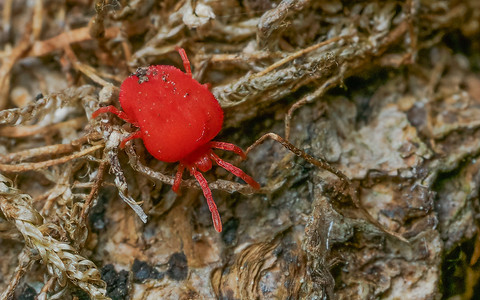
Trombidiidae > Trombidium cf.holosericeum

Trombidiidae > Trombidium cf.holosericeum
Trombidiidae - eyes forked rather than stalked, but not obvious; body soft, rather blobby and somewhat flattened; bright warm red, with plush velvet coat; rear part of idionotum without shield; legs rather short, first two pairs pointing forward, rear pairs backwards. Active predators of small invertebrates. The two primary genera are Allothrombium (3) and Trombidium (7), the former with a slightly different body shape I believe, shorter and thicker legs with a brush-like empodium between the claws. Hopefully, I'll find some more of these species as it would obviously be nice to represent both genera.
Eutrombidiidae - two pairs of lateral stalked eyes; body elongate and appearing rather scrunched up with the rear of the idiosoma bearing a sclerotised shield (like an indentation); dark red and densely coated. The larvae parasitise grasshoppers and with certainly one of the two species, Eutrombidium locustarum being a predator of the eggs, which suggests to me that they are more likely to be found in grassland habitats?
Microtrombidiidae - smaller species, typically under 1mm; paired eyes set in front of the rear shield; densely setose body. Included for reference only at this stage.

Tanaupodidae > undetermied species

Tanaupodidae > undetermied species

Tanaupodidae > undetermied species

Tanaupodidae > undetermied species
Tanaupodidae - two pairs of clearly visible sessile eyes; body setae simple; colour orange-red to brownish. Typically found
in moist litter habitats. More information required. In other systems this family may be separated and placed into its own superfamily Tanaupodoidea.
Trombiculidae - whilst some species have lateral eyes, the British fauna are eyeless; body strongly waisted, broader at the rear and covered in dense setae. Larvae known as 'chiggers'. As with the Tanaupodidae, this family would normally be separated from the Trombidioidea, and placed in another superfamily Trombiculoidea together with the Johnstonianidae and a couple of other families that do not occur in Britain.
Johnstonianidae - eyes sessile, set relatively wide apart on largish prodorsum; body setae simple, somewhat stubbly; legs longish. Terrestrial in all forms, but rarely found away from water and with some species being almost subaquatic.
ACARIFORMES > Trombidiformes > Prostigmata
Eleutherengonides > Raphignathina > Tetranychoidea
The Tetranychoidea comprises two distinct families of 'spider mites', Tenuipalpidae which are actually 'false spider mites' as they do not spin webs and, as such, are often referred to by the alternative common name of 'flat mites', and Tetranychidae where certain species do form webs for protection of their eggs. The former is represented in Britain by a dozen or so species, the latter by around 40 species in 13 genera.
In larger classification systems the Tetranychidae would be divided into two subfamilies, Bryobiinae and Tetranychinae.
They are tiny plant feeders that usually feed on the underside of a wide range of host species. Many are serious pests, especially those in the Eotetranychus, Oligonychus, Panonychus and Tetranychus genera; the most harmful being the two-spotted spider mite Tetranychus urticae which damages various crops as well as ornamental woody and herbaceous plants, and with the females no more than 400µm long are barely visible with the naked eye.

Tetranychidae > Bryobia sp.

Tetranychidae > Bryobia sp.
The Bryobia species as represented here are fortunately a tad larger, averaging around 800µm, but still tiny and difficult to spot. There are around ten valid species on the British list and although some are associated with specific plants, they can't be reliably distinguished. Collectively they are known as 'clover mites'.
They're pretty distinctive mites having a red cuticle with a somewhat flattened dark-coloured body bearing white club-shaped setae. In dorsal view, twelve pairs are usually clearly visible on the opisthosoma - three well-spaced in the centre (c1, d1, e1) and the remaining nine around the margin, plus a further four pairs on the prodorsum although only the back pair are likely to stand out as the other two are on lobes over the gnathosoma. The forelegs are long and typically outstretched.
ACARIFORMES > Trombidiformes > Prostigmata
Eupodides > Bdelloidea
The Eupoides infraorder is the last of the three main higher level taxonomic ranks, sitting alongside Anystides and Eleutherengonides. It encompasses 15 families that are separated into five superfamilies that, apart from the Halacaroidea 'marine mites', are all represented here to some degree.
The Bdelloidea superfamily includes two families of 'snout mites', Bdellidae with 18 species in 6 genera, and Cunaxidae with 6 species in 5 genera. They are relatively fast-moving predatory mites of soil and leaf-litter and, as with many of the mites I photograph, often found on both small pieces of lying deadwood and, occasionally, under bark on fallen timber. I also believe that some species can be found in coastal locations including on the seashore.
I can't find any specific information relating to the British species other than a general description and associated notes for determining the family, however I suspect that there are certain features that might point to the genus. At the moment, I'm happy to confirm that all of the individuals currently featured here are bdellids.


Bdellidae > undetermined species
Bdellidae > undetermined species

Bdellidae > undetermined species

Bdellidae > undetermined species (same individual as above)
They have an oval body and an elongate conical snout that either flows together smoothly or, in the case of the cunaxid species has a constriction at the junction point between the idiosoma and the snout. The bdellids have slender, erect and elbowed palps that are typically tipped with two long setae, whereas in the cunaxids the palps are much thicker and directed forward. The body colour is variable as can be seen, normally bright red to orange, but sometimes yellowish or, especially with some cunaxids, whitish to near translucent. They may have one or two pairs of lateral eyes.

Bdellidae > undetermined species

Bdellidae > undetermined species (same individual)
It's hard to gauge the size sometimes when you're photographing tiny species like these, but I'd say that the three different orange-coloured specimens that look very similar to me, were probably 2-3mm long, whereas the little red-coloured mite that I found under bark was little more than half that size. It was also far more active and rather difficult to photograph.
ACARIFORMES > Trombidiformes > Prostigmata
Eupodides > Eupodoidea
This section should have covered the Eriophyoidea, but I've moved that superfamily down the page as I wanted these species to follow the Bdellidae 'snout mites'. Eupodoidea It's not a particularly large group, but it is an important one from a photographer’s perspective as each family offers some opportunity. The group as a whole are only represented in Britain by 40 or so species, which are separated into five distinct families, Cocceupodidae and Eupodidae, which are sometimes combined, and Penthaleidae, Penthalodidae and Rhagidiidae.
Although I wish I had more photos, there's just enough here for the first issue. The following notes refer and will be amended and adapted in time as new material is added or more information becomes available. The numbers in brackets refer to the number of valid species in that genus.
Cocceupodidae is a relatively new family that separates three genera Cocceupodes (4), Filieupodes (2) and Linopodes (1) that were previously in the Eupodidae. Some authors don't see the need, as the character differences are so minor primarily relating to the placement of certain seta, but the family is recognised in the British classification system and, as such, the Eupodidae family is now reduced to ten species, which are placed in six genera, Benoinyssus (1), Caleupodes (1), Claveupodes (1), Eupodes (5), Neoprotereunetes (1) and Protereunetes (1).
Although the majority of these species are probably far too small to photograph, let alone identify, there are a couple of exceptions. The first is Linopodes motatorius, which is an interesting, very distinctive, active little mite with exceptionally long forelegs, which they use as surrogate antennae to explore their surroundings. In my experience, they are not that easy
to find and can often be frustratingly difficult to photograph as they're almost constantly on the move, but they're certainly a species that needs to be in the portfolio.


Cocceupodidae > Linopodes motatorius

Cocceupodidae > Linopodes motatorius
It then becomes far more difficult except that three of the remaining eight genera, Benoinyssus, Cocceupodes and Eupodes all have enlarged femurs on legs IV, which helps, particularly given that the first two are extremely small with Benoinyssus averaging around 250µm and Cocceupodes only a tad larger, and as such it's pretty safe to assume that if you manage to find and photograph any of the remaining mites in this group that are in the region of say 500-600µm where you can see enlarged femurs they are almost certainly going to be one of the Eupodes species. Another good indicator of the genus is that the forelegs are generally as long or slightly longer than the body. They are variable in colour, either dark with orange legs, or pale yellowish to brownish often with a feint midline and typically with flecked markings and with either unicolourous or lighter legs. The body is generally oval in shape and slightly tapered, with a clear distinction between the gnathosoma and the idiosoma. The colour however is not regarded as an identification feature and, in fact, only a relatively small number of the known species of the genus can be reliably determined. But, with only five British species, other features may be observed, such as Eupodes unifasciatus having a shiny 'nose' that reflects light almost as well as the eyes.

Eupodidae > undetermined Eupodes sp.

Eupodidae > undetermined Eupodes sp. (on garden waste bin)

Eupodidae > likely Eupodes unifasciatus (on garden waste bin)

Eupodidae > likely Eupodes unifasciatus (on garden waste bin)
The Penthalidae family includes 6 species in 3 genera Halotydeus (2), Linopenthalus (1) and Penthaleus (3), the latter distinguished by having a dorsal anal opening as clearly visible in the following photos where the individual is excreting excess fluid. Penthaleus major is the best-known member of the family as they are a major pest species that in various areas of the world attacks various crop plants including peas, cotton, peanuts, wheat and other grains. They are part of a complex called either 'blue oat mites' or 'winter grain mites' as they are particularly active during the autumn and winter months when the temperature drops. They're very distinctive little mites with a dark bluish-black coloured body with a reddish patch in the vicinity of the anal opening, and relatively long orange-red legs.

Penthalidae > Penthaleus major (on garden waste bin)

Penthalidae > Penthaleus major (on garden waste bin)
As its name suggests, Halotydeus destructor is a well-known and particularly destructive member of the family that are common pests of vegetable and legume crops, tobacco and grasses, but that species does not occur in Britain or, I believe, in Europe. We do, however, have two other members of the genus, Halotydeus hydrodromus and Halotydeus signiensis, but neither of those species are going to be found in my area.
Not to be confused with the previous family, Penthalodidae includes 4 species in the Penthalodes genus. They are well-sclerotised, ornamented mites that have a conspicuous V or Y-shaped furrow on the dorsal shield. I have seen this species but, unfortunately, I don't have any photos so will refrain from adding any further comments at the moment.

Rhagidiidae > undetermined genus/species

Rhagidiidae > undetermined genus/species
Rhagidiidae is the largest of the Eupodoidea families with 16 species in 7 genera. They are fast-moving, soft-bodied predatory mites that typically have an opaque white and/or yellowish, elongate oval body which, certainly with the individuals I've seen, has clear demarcation between the gnathosoma and idiosoma. The large pincer-like chelicerae extend forward and, if you were looking at a specimen under a microscope, would likely provide diagnostic characters that would determine the genus and/or species. Another key feature is the arrangement of ingrowing setae on the ends of the legs called rhagidial organs, but of course they're not possible to distinguish from a macro photograph, so individuals are typically left as undetermined. However, if you find one of these mites with particularly large chelicerae it would likely imply the genus Poecilophysis (3), or if it had rather fat forelegs it would probably be Shibaia (1). And, although much harder to see, club-shaped prodorsal setae would indicate indicate Coccorhagidia (2).
Rhagidiid species, or 'rhaggies' as one well-known expert affectionately calls them, are primarily found in leaf-litter and upper soil levels, or sometimes under bark especially on deadwood lying on the ground. They favour moist, cool habitats and, because they lack eyes, they prefer dark or relatively dark places so, in the right environment, may also be found under stones and rocks. I assume they're light sensitive as they have a tendency to run around erratically when exposed which, of course, makes them even more difficult to photograph!

Rhagidiiidae > undetermined genus/species

Rhagidiiidae > undetermined genus/species
Location / habitat notes: Apart from the species that I've found on the rim of the garden waste bin that would have been inadvertently collected while maintaining the garden and then subsequently managed to make their way to the surface, all of the remaining individuals featured in this section were found under deadwood. In most cases, apart from one of the featured Linopodes motatorius species that I spotted in the garden, the others were all photographed in local woodland, including a couple of locations in the New Forest, but also at Horton Wood and Ringwood Forest, which are primarily coniferous.
ACARIFORMES > Trombidiformes > Prostigmata
Eupodides > Eriophyoidea
This group of phytophagous, sap-sucking, plant-feeders could easily have been omitted, but it warrants a mention even though it's not possible to include photos of any of the actual mites.
The Eriophyoidea superfamily as represented in Britain comprises the small Diptilomiopidae 'leaf vagrant mites' family with just six species in four genera; the not much larger Phytoptidae family with eleven known species in four genera that are either 'leaf vagrants' or 'rust mites'; and the very large Eriophyidae family of over 200 species that are collectively known as 'gall mites' that are placed in 24 genera, the largest by far being Aceria with 94 recognised species, and Eriophyes with 28 species.
These mites are typically extremely small, averaging around 100-150µm with relatively few that are larger. Virtually all casual observations will be related to the host plant reaction rather than the actual mite. They are soft-bodied, four-legged, grub-like mites that look totally different to any of the other mite species that I've featured.
The diptilomiopid species usually cause little damage, mainly browning or rusting of the leaves and, as such, are known as 'leaf vagrant mites'. The phytoptid mites near enough fall into the same category. The eriophyid species are the bad boys, not all, but collectively they are regarded as pest species that usually cause damage by inducing galls, although some only discolour the leaves and are individually referred to as 'rust mites'. Some are also known to transmit plant disease.
Two well-known representative species are Acalitus longisetosus, which feeds on Betula (Birch) producing felt-like 'erinea' open-galls on the upper surface of the leaves, both between and along the veins; and Eriophyes laevis, which feeds on Alnus (Alder) inducing small shiny yellow galls that turn green and then develop into red or purplish-coloured blisters. The following photos are particularly good examples.

Eriophyidae > Acalitus longisetosus (as described above)

Eriophyidae > Eriophyes laevis (as described above)
ACARIFORMES > Trombidiformes > Prostigmata
Eupodides > Tydeoidea
I was in two minds whether to include this superfamily as the species are so small but, more for future reference than anything else, here are some brief notes regarding the various families, Ereynetidae, Iolinidae, Triophtydeidae and Tydeidae which collectively include around 30 species in a dozen genera.
Ereynetidae - this diverse family, which includes both predatory and parasitic mites, is only represented in Britain by six or seven species; five Ereynetes spp., which are tiny free-living predatory mites that live in soil and litter; and, although worldwide a number of members of the family are associated with various terrestrial arthropods and gastropods, just two Riccardoella spp. that live on slugs and/or snails.
The most likely species to be seen is the 'white slug mite' Riccardoella oudemansi, which primarily lives on slugs, but can sometimes be found on snails. The other is Riccardoella limacum which is mainly associated with snails and, not surprisingly, is known as the 'white snail mite'. Both of these mites may spend their whole life on the same slug or snail and, unless there are too many parasitising the same host, they do not cause harm even though they may puncture the skin to feed on the blood as well as the mucus. They can't be distinguished from photos and can barely be separated under a microscope and, in fact, only the former is currently considered a valid British species despite both being recognised. I haven't actually tried looking for one, but I guess that at some point I will.
As far as I'm aware, none of the remaining species are parasites, but they do have a wide diversity of feeding habits that I haven't really explored as I doubt whether I'm going to photograph many of them. The Iolinidae includes eight species in five genera, and the Triophtydeidae has just a single species. The largest family is Tydeidae with 15 species in four genera. They constitute a mixture of plant feeders, fungivores, predators and scavengers. I'm not sure whether the individuals featured here are typical, but the members of the family as a whole are described as having a generally broad-shaped body coupled with short, tapering legs. By comparison, the Iolinidae spp. have a more elongated body form with slightly chunkier legs. The tick was about 3mm long, and it was only after I started to photograph it that I noticed the mites. They were kindly identified as members of the Tydeidae family by an expert on the Soil Biodiversity UK group.

Tydeidae > undetermined genus/species (heavily cropped photo)

Tydeidae (original photo showing size comparison - see above)
Created June 25 | updated July 25 (v.2)