Small World Discoveries
by Tony Enticknap - tickspics
Focusing on insects, arachnids, fungus and other small nature subjects from East Dorset and the New Forest ...
Pteromalidae
Pteromalid wasps
HYMENOPTERA > APOCRITA | Parasitica > Chalcidoidea > Pteromalidae
The Pteromalidae family has been widely used as a polyphyletic 'dumping ground' of sorts for Chalcidoidea taxa that couldn't be properly assigned to one of the established families. Over time it had grown to become an extremely large and problematic group that, on a worldwide basis, included around 3,500 species spread across 640 or so genera, which historically had been separated into 33 subfamilies.
That situation is now changing as the family is currently being broken down following research carried out to establish '... a monophyletic Pteromalidae and reclassification of Chalcidoidea' (Burks et.al.2022) which has resulted in many of the former subfamilies being elevated to family status and with some genera or tribes being placed in alternative families.
According to the last published version of the 'Checklist of British and Irish Hymenoptera' updated in June 2016, there were 570 recognised species of pteromalid wasps that had been recorded in the UK which, for convenience, were split into two listings: the Pteromalinae (373), and then the remaining subfamilies, which at the time were: Asaphinae (4), Ceinae (4), Cerocephalinae (4), Cleonyminae (3), Colotrechninae (1), Diparinae (1), Eunotinae (4), Macromesinae (1), Miscogastrinae (83), Neodiparinae (1), Ormocerinae (16), Pireninae (67) and Spalangiinae (8).
Unfortunately downloadable pdf versions are no longer available as the list is now maintained in digital format only on the Universal Chalcidoidea Database, which is great for specific searches, but not particularly useful if you simply want to view the current structure.
My understanding, if correct, suggests that the remaining British representatives of the family are now placed in just five subfamilies: Asaphesinae (formerly Asaphinae), Coltrchninae, Miscogastrinae, Ormocerinae and Pteromalinae. It's difficult to reconcile how many species are in each subfamily, but assuming there haven't been any significant changes, the family would now have 477.
The former upgraded subfamilies, now reclassified: Ceidae (4), Cerocephalidae (4), Cleonymidae (3), Diparidae (1), Eunotidae (4), Macromesidae (1), Neodiparidae (1), Pirenidae (67) and Spalangiidae (8) have been removed and are separate distinct families in their own right.
Pteromalids are tiny (1.2 - 2.7mm) metallic, mostly green, parasitic wasps that were broadly characterised by having five segmented tarsi especially of the fore and hind legs, and antennae of at least seven, but normally eight to thirteen segments. Other features regarding the general shape and relative size of the head and body, position of the antennae etc were variable and separately defined for each subfamily.
The majority are ectoparasitoids of the larvae or pupae of Lepidoptera, Coleoptera, Diptera or other Hymenoptera species, although some develop as endoparasitoids.
Updated morphological diagnosis is now being made available for each subfamily and/or emergent family as a result of the reclassification that will eventually lead to a complete and current assessment of the Chalcidoidea leading to a planned book and keys for identification.
However, from a casual observer's perspective these tiny wasps are rarely seen and, due to their size and often active nature, can be rather difficult to photograph with sufficient detail for identification beyond family level.
I really wish I could feature more examples, but at present I've only photographed the one individual seen here which, despite the previous comment, was positively identified by an expert as belonging to the Pteromalinae > Pteromalus genus.
New family account, May 2026 (v.1)
.jpg)
Pteromalus sp.
Garston Wood, Cranborne Chase, East Dorset | March 25
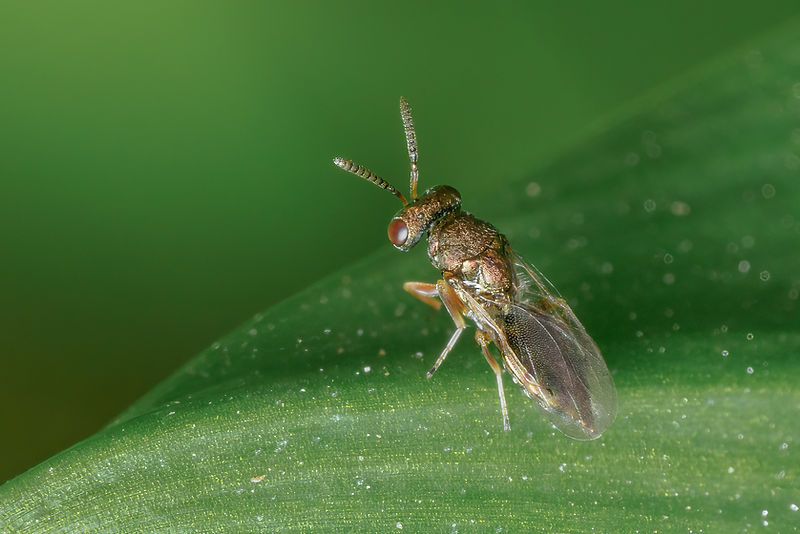.jpg)
Pteromalus sp.
Garston Wood, Cranborne Chase, East Dorset | March 25
.jpg)
Pteromalus sp.
Garston Wood, Cranborne Chase, East Dorset | March 25
