Small World Discoveries
by Tony Enticknap - tickspics
Focusing on insects, arachnids, fungus and other small nature subjects from East Dorset and the New Forest ...
Figitidae
Figitid wasps
HYMENOPTERA > APOCRITA | Parasitica > Cynipoidea > Figitidae
The last publicly available checklist of the British and Irish representatives of this family, published March 2017, confirmed 127 species of which 111 had been recorded in England.
Figitidae is now separated into five distinct subfamilies: Anacharitinae (8), Aspicerinae (7), Charipinae (38), Eucoilinae (64) and Figitinae (10).
Previously regarded as a separate family, Eucoilinae is the largest and probably the best-known subfamily. They range in size from about 1.5mm to 5mm at most. The body is usually shining black or brown. The male antennae have 15 segments, with the third and fourth modified to bear sex glands. The female antennae are shorter, with 13 segments and often with a swollen club. Importantly though, they have a unique diagnostic feature being a distinctive raised and often sculptured plate or cup on the dorsal surface of the scutellum that is not found in any other group of parasitic wasps. It varies in size and shape, and under a microscope would aid identification.
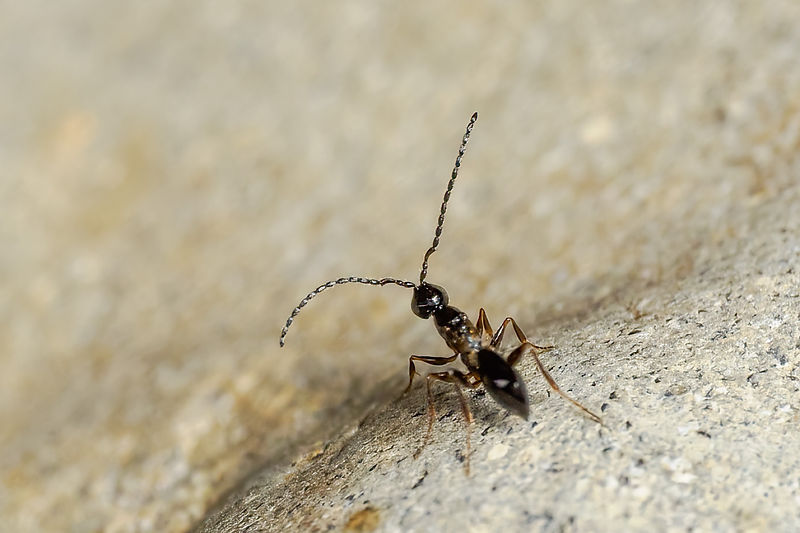
A number of species are known to be associated with beach wrack, notably certain members of the Kleidotoma genus. Species are keyed from females and although the genus is described as being distinct due to various features such as a striate scutellar disc, venation of the forewing and a hairy ring on the second tergite, I think it's unlikely that any of those characters are going to be identifiable in photos. The individuals featured below, both male and female, are believed to be members of the genus and are likely Kleidotoma subaptera based on habitat and geographic location, but also, that in the female, antennal segment 3 is almost as long as 4+5. Wings brachypterous.
All of the members of this subfamily are known endoparasitoids of cyclorrhaphous dipteran larvae and apart from the few species that inhabit the seashore are typically found in soil and leaf litter.
And a few notes regarding the other subfamilies:
Anacharitinae - tergite T2, being the first tergite of the gaster, longer than T3 when measured at or above the middle line in side view; petiole longer than wide; mesonotum always shiny; scutellum with a pair of shallow lateral depressions; head wider than the body. Parasitoids of Neuroptera (lacewing) larvae.
Aspicerinae - tergite T2 shorter than T3; petiole shorter than wide; mesonotum appears dull due to dense granular surface sculpture. Parasitoids of cyclorrhaphous dipteran pupae, and with some literature making specific mention of hoverflies (Syrphidae). Possibly associated with dung.
Charipinae - very small species, 0.8 - 2mm body length; gaster laterally compressed with a ring of pubescence at the base of tergite T2; pronotum sharply angled towards the front; both winged and wingless species. Characters are often insufficient or unreliable to identify species beyond the genus. Parasitoids of aphids (Aphididae) and psyllids (Psyllidae).
Figitinae - tergite T2 shorter than T3; petiole shorter than wide; mesonotum always smooth; eyes usually with long hairs or, if the hairs are short, the scutellum bears a short spine or tooth. Mostly endoparasitoids of undefined Diptera larvae.
New family account, May 2026 (v.1)
.jpg)
Kleidotoma sp. (male) - likely Kleidotoma subaptera
Kimmeridge Bay, Isle of Portland, Dorset | June 25
.jpg)
Kleidotoma sp. (male) - likely Kleidotoma subaptera
Kimmeridge Bay, Isle of Portland, Dorset | June 25
.jpg)
Kleidotoma sp. (male) - likely Kleidotoma subaptera
Kimmeridge Bay, Isle of Portland, Dorset | June 25
.jpg)
Kleidotoma sp. (female) - likely Kleidotoma subaptera
Kimmeridge Bay, Isle of Portland, Dorset | June 25
.jpg)
Kleidotoma sp. (male) - likely Kleidotoma subaptera
Kimmeridge Bay, Isle of Portland, Dorset | June 25
