Small World Discoveries
by Tony Enticknap - tickspics
Focusing on insects, arachnids, fungus and other small nature subjects from East Dorset and the New Forest ...
Braconidae
Braconids
HYMENOPTERA > APOCRITA | Parasitica > Ichneumonoidea > Braconidae
Braconidae are closely related to the Ichneumonidae with both families grouped together in the Ichneumonidea superfamily as previously noted. Whilst braconids are typically smaller and darker coloured than ichneumon wasps, some species are superficially similar, so they cannot be separated on that basis alone. In fully winged forms, the primary distinguishing feature is that in the Braconidae, forewing vein 2m-cu is absent, whereas in Ichneumonidae this vein is always present although sometimes difficult to see. Some other features apply, but having a clear view of the wing venation is an important starting point. Separation is a little more difficult in wingless or brachypterous forms.
There are over 1300 recognised species on the British list in 140 or more genera, separated into numerous subfamilies and/or tribes. Each subfamily has defined characters that enable the experts who deal with these species to place them accordingly. I've only photographed a few braconids and, as yet, have not been able to confirm identity at any level without help.
Accordingly, I'm simply using this page to feature a few species where the subfamily has been determined and, in some cases, where the genus or species has been confirmed. I might change the layout at some point if I have further examples, but for now I'm just including a few notes regarding the respective subfamilies.
Alysiinae
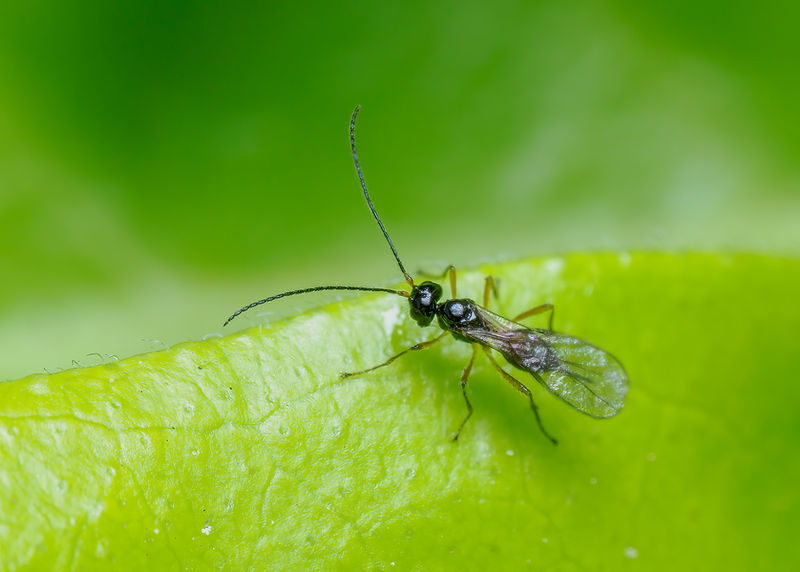
This is the largest subfamily with around 350 species in nearly 40 genera, which are separated into two distinct tribes, Alysiini and Dacnusini; the former primarily distinguished by the forewings having three submarginal cells, whilst the latter only has two. However, in some genera there are apterous or brachypterous forms, where tribal placement can be problematic. Alysiines are recognised by their short, broad and outwardly curving 'exodont' mandibles, which is fine if you have a detailed photo of the face, otherwise not so easy!
All species are koinobiont endoparasitoids of cyclorrhaphous Diptera where the fly larvae (maggots) pupate inside a cocoon-like skin, which has a circular-seamed cap that is normally opened by being pumped out of the head of the emerging adult. A female alysiine will oviposit into the host larvae with the wasp pupating in, and then later emerging from the fly's puparium which they have to puncture with their mandibles in order to escape.
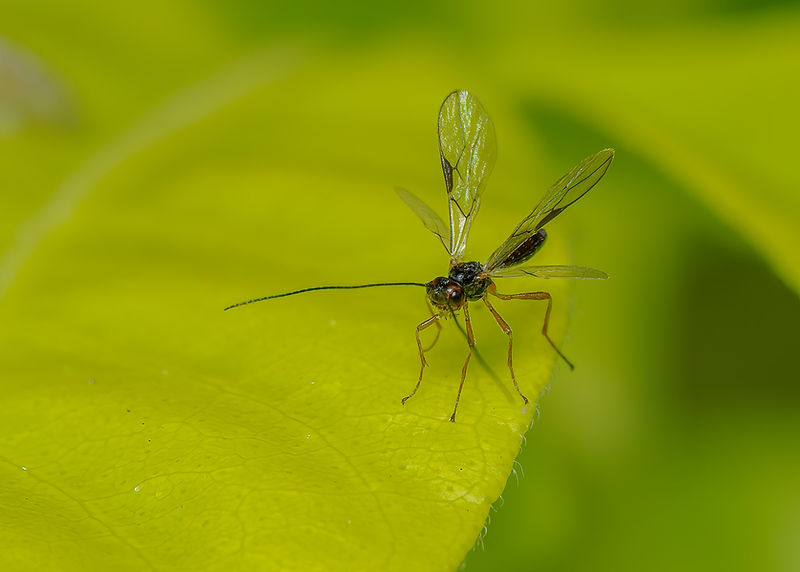
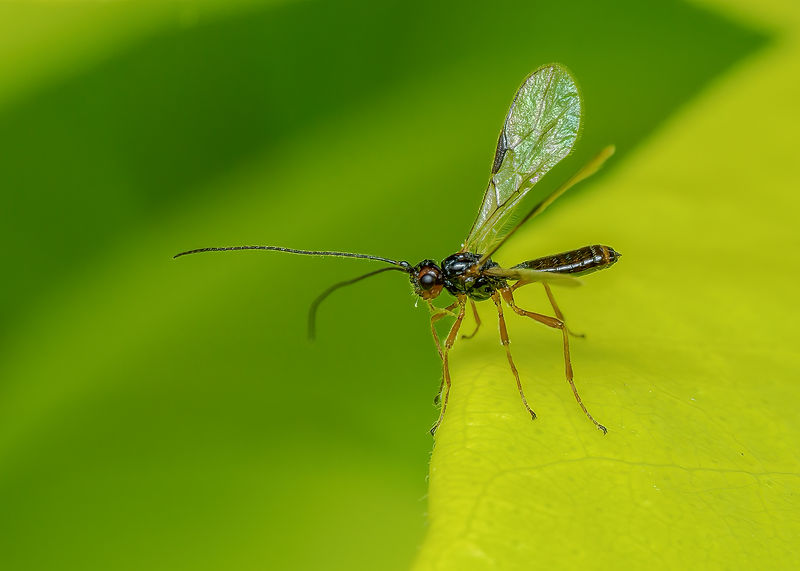
Phaenocarpa ruficeps is a relatively common, medium sized (3-3.5mm), shiny, black-bodied species with a noticeably wide head, which is yellowish to rufous brown around the slightly protruding eyes; long, 25-29 segmented antennae; yellow legs; and hyaline wings that are longer than the body, with brown stigma where the proximal half is roughly equal width throughout. There are 20 species in the genus so a degree of caution is necessary, but this particular species appears to be the most likely candidate.
Braconinae
This subfamily includes just over 90 species in two tribes, Braconini and Coeloidini, but is completely dominated by the Bracon genus that comprises around 85 species in various genera. They are extremely difficult to identify and obtaining confirmation that an individual is in this genus is the very best you can hope for from photos. Most species are idiobiont ectoparasitoids of wood or stem boring Coleoptera and Lepidoptera concealed larvae.
Opiinae
The taxonomic arrangement of this large subfamily seems to differ from one source of reference to another, but I believe there are around 115 species in 18 or 19 genera, but with no tribal separation. A specific feature, although not necessarily one that confirms the subfamily, is that forewing vein 2Rs is usually conspicuously longer than 1Rs as can be clearly seen in the photo of the specimen featured below. Distinguishing the genus is extremely unlikely from a photo. Although they're mostly associated with plant-eating flies, such as certain members of the Agromyzidae, Anthomyiidae and Tepritidae families, their biology is very similar to that of the closely related Alysiines.
Rogadinae
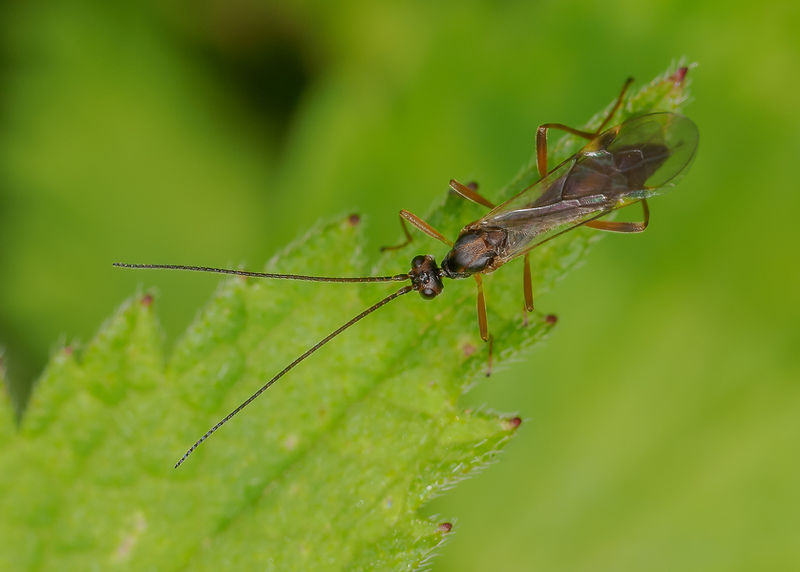
This family are caterpillar endoparasites that 'mummify' their hosts by turning them into hardened husks inside which the parasitoid larvae will develop before emerging as an adult wasp. There are 48 species in just four genera that are placed in three tribes, Aleiodini which is the primary group mainly comprising members of the Aleiodes genus, and then two very small tribes, Clinocentrini and Rogadini. The individual featured here has been verified, but with 38 species in the genus further identification is not possible.
Updated, May 26 (v.3)
.jpg)
Alysiinae - Phaenocarpa ruficeps
Three Legged Cross (garden), East Dorset | May 26
.jpg)
Alysiinae - Phaenocarpa ruficeps
Three Legged Cross (garden), East Dorset | May 26
.jpg)
Alysiinae - undetermined species
Three Legged Cross (garden), East Dorset | May 26
.jpg)
Braconinae - Bracon sp.
Cashmoor Down, East Dorset | April 24
.jpg)
Opiinae - undetermined species
Garston Wood, Cranborne Chase, East Dorset | Oct.24
.jpg)
Rogadinae - Aleiodes sp.
Sovell Down, Gussage St.Michael, East Dorset | April 22