Small World Discoveries
by Tony Enticknap - tickspics
Focusing on insects, arachnids, fungus and other small nature subjects from East Dorset and the New Forest ...
Staphylinidae
Rove beetles (1)
COLEOPTERA > POLYPHAGA > STAPHYLINOIDEA > Staphylinidae
A very large family of over 1100 species including over a quarter of all recorded British beetles. Although a few of the more distinctive species are well described, the family as a whole is generally regarded as a very difficult group that many casual observers avoid. The informed and dedicated coleopterists call them 'staphs', but to everyone else they're Rove Beetles.
They are mainly elongate, typically dark, brown or black, but often with some reddish colouration, and characterised by having short elytra that leaves most of the terminal segments exposed. As expected with such a large family there's considerable variation in size, with some species being tiny at just a couple of millimetres whist others, notably Ocypus olens commonly known as the Devil's Coach-horse, can reach 30mm. There's also a great deal of variety in terms of habitat and life style.
Taxonomically the family is separated into 19 subfamilies and various tribes. Some of these subfamilies are small with few species, whilst others, notably Aleocharinae with over 450, are very large with little chance of identification from photos.
My current knowledge is very limited, but by carefully going through the information that's available on the excellent 'UK Beetles' website I can usually establish the subfamily and, with a bit of extra research, may be able to determine the tribe or even the genus, very rarely the species. Fortunately, the non-associated FB Beetles group helps people confirm identity and, certainly in respect of this particular family, I use it a lot to ensure that my personal records are correct.
The following are some brief notes regarding the species I've photographed and have been able to identify.
Phyllodrepa sp. | Omaliinae > Omaliini
A small, but difficult genus with just four species, although one appears to have never been officially recorded and two others are rare. The most frequently observed is Phyllodrepa floralis, but the normal habitat of that species and a couple of the identifying features associated with the head and the antennae don't correspond here. This large-eyed individual, which was keyed out by an expert, is more likely to be one of the rare forms, Phyllodrepa salicis.
Phloeonomus punctipennis | Omaliinae > Omaliini
Tiny, no more than 2mm long. Nondescript, but the size and shape of the pronotum help to distinguish the genus of which there are two very similar species. They are difficult to separate, apart from under a microscope, but Phloeonomus punctipennis has slightly more defined and longer pronotal depressions that extend further forward than in Phloeonomus pusillus.
Proteinus sp. | Proteininae
A smooth, weakly shining, tiny beetle barely 2mm long, with a distinctive shape. Five rather similar species in the genus, all of which could be found on fungi, dung or decaying vegetation. Identification unlikely from photos.
Cephennium gallicum | Scydmaeninae > Cephenniitae > Cephenniini
Another really tiny species, well under 2mm in size with a distinctive hairy appearance. Rarely photographed during the day as they're most active at night when they hunt oribatid mites, so I was lucky to find this particular individual tackling a Steganacarus ptychoid mite which had curled up into a protective ball.
Tachyporus hypnorum |Tachyporinae > Tachyporini
Small, barely 4mm, but distinctive due to their body shape and dark colouration; very common and widespread.
Habrocerus capillaricornis | Habrocerinae
Sole representative of the subfamily. Very small, around 3mm, shiny brownish-black with paler appendages. Antennae inserted laterally in front of the eyes, eleven-segmented, each with a distinctive ring of several long erect setae.
Drusilla canaliculata | Aleocharinae > Lomechusini
Adults are typically 4-5mm long and can be identified by their distinctive shiny dark-red colouration and the deep indentation in the pronotum.
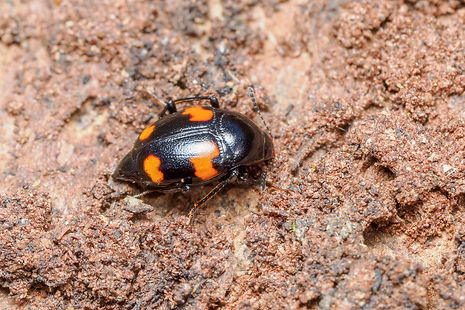
Scaphidium quadrimaculatum | Scaphidiinae > Scaphidiini
Unmistakable, 5-6mm, broad rounded body with four red marks, very different to other rove beetles. One of five species in the subfamily, all associated with decaying wood and fungus.
Continues on the next page .....
Updated, April 26 (v.4)
.jpg)
Phyllodrepa sp. (possibly Phyllodrepa salicis)
Garston Wood, Cranborne Chase, East Dorset | April 25
.jpg)
Phloeonomus punctipennis
Barrow Moor, Bolderwood, New Forest | Jan.24
.jpg)
Cephennium gallicum
Barrow Moor, Bolderwood, New Forest | June 25
.jpg)
Tachyporus hypnorum
Three Legged Cross (garden), East Dorset | March 21
.jpg)
Habrocerus capillaricornis
Kitt's Grave (woodland), East Dorset | Oct.22
.jpg)
Scaphidium quadrimaculatum
Kitt's Grave (woodland), East Dorset | Sept.22

.jpg)
Phyllodrepa sp. (possibly Phyllodrepa salicis)
Garston Wood, Cranborne Chase, East Dorset | April 25
.jpg)
Proteinus sp.
.jpg)
Cephennium gallicum
Barrow Moor, Bolderwood, New Forest | June 25
.jpg)
Tachyporus hypnorum
Garston Wood, Cranborne Chase, East Dorset | Jan.25
.jpg)
Drusilla canaliculata
Slepe Heath, Isle of Purbeck, Dorset | May 22
.jpg)
Scaphidium quadrimaculatum
Spearywell Wood, Nr.Romsey, Hampshire | April 25