Small World Discoveries
by Tony Enticknap - tickspics
Focusing on insects, arachnids, fungus and other small nature subjects from East Dorset and the New Forest ...
Curculionoidea
Weevils (6)
COLEOPTERA > POLYPHAGA > CURCULIONOIDEA > Curculionidae
This final page brings together the three remaining species I've photographed from some of the smaller subfamilies that have not been previously covered.
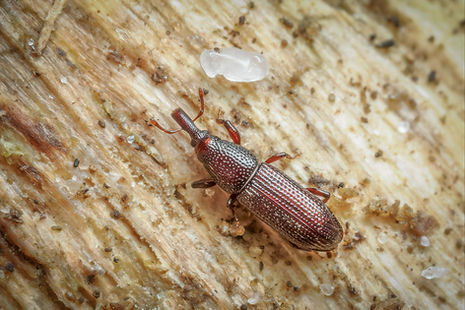
Although the Cossoninae subfamily is only represented in Britain by 15 species, they're spread across thirteen genera and six tribes. They're primarily associated with decaying timber and are mainly small, dark-coloured beetles with a flattened elongate body. Unless I was specifically looking for Pselactus spadix in washed-up driftwood on the seashore, there are probably only two or three species that I'm likely to encounter in local woodland. The most frequently observed is Euophryum confine as featured here, which is a tiny wood borer little more than 3mm long. The other two, Phloeophagus lignarius and Stereocorynes truncorum, are much the same size and similar in some respects, but with a broader body.
The Hyperinae (cocoon weevils) subfamily includes 18 species, fourteen of which are in the Hypera genus and two each in Brachypera and Limobius. A general description for the two main genera Hypera and Brachypera confirms, square shoulders, rather straight-sided wing-cases, a thick rostrum with antennae inserted near the tip, and the importance of the shape of the scales on the wing-cases when trying to distinguish the species, particularly with Hypera. Of the two Brachypera species, only Brachypera zolius is widespread but, even so, not that common. It has a broader body and a short and very thick rostrum.
Molytinae includes 17 species in 11 genera that are separated into seven distinct tribes; a diverse group where most species are either scarce or rare and infrequently recorded, although some are locally common, but restricted by habitat. They are varied in morphology with few common features other than the head is small with large flattened eyes, a long robust rostrum and geniculate antennae with a long scape and distinct clubs. Having looked closely at the available distribution data, apart from the featured species below, I can only find two that could possibly be found locally; Hylobius abietis and Pissodes castaneus, both of which are associated with coniferous pine woodland. There are literally only a couple of records of each species from either Dorset (VC9) or South Hampshire (VC11), but they're two species that I'll be looking out for.
The Molytini tribe includes seven species in four genera that have been further divided into separate subtribes. The Molytina includes two Liparus species, which are our largest weevils. I believe that they are both 'nationally scarce'. The largest at 13-15mm is Liparus germanus which, as far as I'm aware, has only been recorded from a few sites in Kent. The species that I found Liparus coronatus, seen on two occasions at the same location, is a tad smaller and more widespread with scattered sightings across the south, albeit only with around 300 confirmed records.
Updated, April 26 (v.2)
.jpg)
Euophryum confine
Redman's Hill, Three Legged Cross, East Dorset | April 25
.jpg)
Brachypera zolius
Three Legged Cross (garden), East Dorset | Sept.22
.jpg)
Liparus coronatus
Badbury Rings, Wimborne, East Dorset | June 24
.jpg)
Liparus coronatus
Badbury Rings, Wimborne, East Dorset | April 24

.jpg)
Euophryum confine
Redman's Hill, Three Legged Cross, East Dorset | April 25
.jpg)
Brachypera zolius
.jpg)
Liparus coronatus
Badbury Rings, Wimborne, East Dorset | April 24
.jpg)
Liparus coronatus
Badbury Rings, Wimborne, East Dorset | June 24