Small World Discoveries
by Tony Enticknap - tickspics
Focusing on insects, arachnids, fungus and other small nature subjects from East Dorset and the New Forest ...
Coccinellidae
Ladybirds (3)
COLEOPTERA > POLYPHAGA > COCCINELLOIDEA > Coccinellidae
The Coccinellidae family is typified by the brightly coloured, predominantly red, black spotted species that, in Britain, we know as ladybirds rather than ladybugs or lady beetles. When ladybirds are discussed in a casual, rather than specific context, the associated article will invariably be accompanied with a photo of one of the common species; probably the photogenic 7-spot.
Having separated the non-conforming black, brown, beige and yellow, black spotted ladybirds, this page is reserved for the red or orangey-red species, apart from the Harlequin, which is featured separately.
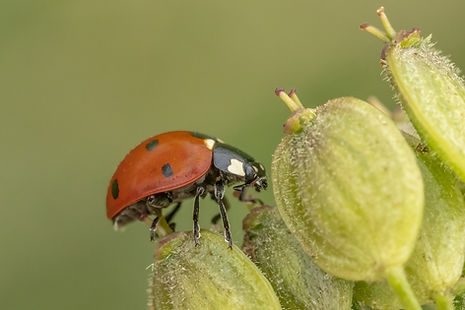
The 7-spot Ladybird [Coccinella septempunctata] is by far the most common and widespread form, so common in fact that it's one of a number of insects that I tend to ignore, which immediately becomes apparent when you realise you don't have many photos of them. As well as being a very familiar garden insect that is often seen feeding on aphids, it can also be found in wide range of more natural habitats including both deciduous and coniferous woodland, heathland, grassland and scrub, or various coastal locations. Although the spots can be slightly variable, it could only be confused with the 'nationally scarce' variety Coccinella magnifica which is a very local species that is only likely to be found in close proximity to wood ant nests where it is most commonly found on Scots Pine. The two are extremely similar, although the Scarce 7-spot Ladybird, as it's commonly called, typically has slightly larger centre spots that might be noticeable enough to warrant checking if found in the right habitat. However, it can only be reliably distinguished by checking and photographing the underside where it has distinctive white markings near the base of the legs.
I thought it had taken me a while to find my first 10-spot Ladybird [Adalia decempustulata] until I discovered that I'd actually photographed one of the alternative forms a couple of years back. I just hadn't appreciated that this particular species was so variable. The 'typical' form (decempunctata) has an orangish to red background colour with variable markings, both in regards of the number of spots which could be anything from none to ten, but also whether they're clearly defined or faded. Then there's a chequered variety (decempustulata) with a black background and large red or orange blotches that form an attractive pattern. And, finally, a 'melanic' form (bimaculata) that could be predominantly dark brown or black with a couple of vague spots. This level of variation could lead to confusion with other species, such as a couple of forms of the similar-sized 2-spot, but more likely the Harlequin (succinea) or intermediates, which was the mistake I made in assuming that the chequered (decempustulata) individual featured below was an unusual Harlequin.
The 2-spot Ladybird [Adalia bipunctata] is another species that has different colour variations, each distinctive in their own way to have been given specific names. In addition to the regular red form (typica) that has two black spots, there are two further variations (bar annulata and intermediate annulata) that have black blotches or bar markings. And, two more that have a black rather than red background colour with either four red spots (quadrimaculata) or two large red blotches at the front and four red spots at the back (sexpustulata). Additionally, if that wasn't enough variation, the pronotum can be either white with black markings or almost entirely black. The alternative form seen here (quadrimaculata) is probably the most likely to be confused as it could be mistaken for either the black 10-spot (bimaculata) or a Harlequin (form spectabilis) as featured on the next page.
Unlike the 7-spot Ladybird which is typically found on low-level vegetation, the 10-spot and 2-spot varieties are often found on trees. The 10-spot is more habitat specific than the 2-spot and that could be another factor regarding why I haven't found more of these species. Hopefully, I will get the opportunity to photograph some of the variant forms and, over time, improve my records so that I can get a better understanding of where they are likely to be found.
The widespread, albeit not so frequently recorded 11-spot Ladybird [Coccinella undecimpunctata] can be more orangey-red than pure red, but apart from some individuals having fused spots or feint yellow rings around the spots similar to the much rarer Eyed Ladybird, the general colour and form is reasonably consistent. It could possibly be confused with the 'nationally scarce' Adonis Ladybird as that species also favours dry habitats, but can be distinguished by the colour and markings on the pronotum. Interestingly, the individual featured below was one of the very first beetles that I ever photographed and it was only while I was updating this collection that I realised that I hadn't seen once since. I'm not sure if that's actually true, but I certainly haven't photographed any more, which is probably a result of not paying enough attention or simply not being in the right habitat.
The 24-spot Ladybird [Subcoccinella vigintiquattuorpunctata] is an orangey-coloured, hairy grassland species that, by definition of its common name, should have 24 spots, except that it rarely does! A well-marked individual may have 11 variably-sized spots on each elytron, plus another centrally on the pronotum with a smaller indistinct one either side that, more often than not, are fused together, sometimes to the point where they virtually cover the complete dorsal surface. Similarly with the elytra where some spots maybe merged into blotches. And, apart from the many different forms that those variations can produce, individuals such as the one featured below may be completely spotless! In some areas, particularly around London, it could be initially mistaken for the much scarcer Bryony Ladybird, except that species is noticeably larger and has fewer, more discrete spots.
Before moving on to the Harlequin Ladybird featured on the following page, there are a few observations that I want to note that I wasn't aware of when I penned my original comments regarding this family. The first point is that some of these species aren't quite as straightforward to identify as I thought. I now have a dedicated 'field guide' which has opened my eyes to that fact, as I hadn't appreciated the number of similar species or variant forms. I now have a much better understanding and have found it useful reading up on each species and compiling a list that I can target. Importantly, in that respect, I'm going to have to be more specific with the locations I visit if I want to find new species. Although I spend a fair amount of time in most habitats, conifer forests have always been way down the list simply because they've never produced much. But, I guess, that's because I haven't put the time in, so having now seen that four of my main target species, Eyed, Striped, Cream-streak and 18-spot are only likely to be found in coniferous woodland, I'm going to have to find some suitable local sites.
New page added, Feb.25 (v.1)
.jpg)
7-spot Ladybird
Cashmoor Down, East Dorset | June 21
.jpg)
7-spot Ladybird
Cashmoor Down, East Dorset | July 21
.jpg)
2-spot Ladybird (form typica)
Three Legged Cross (garden), East Dorset | Aug.21
.jpg)
10-spot Ladybird (form decempunctata)
Badbury Rings, Wimborne, East Dorset | April 24
.jpg)
10-spot Ladybird (form decempustulata)
Blashford Lakes, Nr.Ringwood, Hampshire | May 22
.jpg)
24-spot Ladybird
Kitt's Grave (woodland), East Dorset | May 24
.jpg)
24-spot Ladybird (spotless form)
Kitt's Grave (woodland), East Dorset | Sept.22

.jpg)
7-spot Ladybird
Three Legged Cross (garden), East Dorset | Feb.21
.jpg)
7-spot Ladybird
.jpg)
2-spot Ladybird (form quadrimaculata)
Fishlake Meadows, Romsey, Hampshire | May 24
.jpg)
10-spot Ladybird (form decempunctata)
Badbury Rings, Wimborne, East Dorset | April 24
.jpg)
11-spot Ladybird
Longham Lakes, Nr.Ferndown, East Dorset | July 20
.jpg)
24-spot Ladybird
Kitt's Grave (woodland), East Dorset | May 24